Why is Pai so popular?
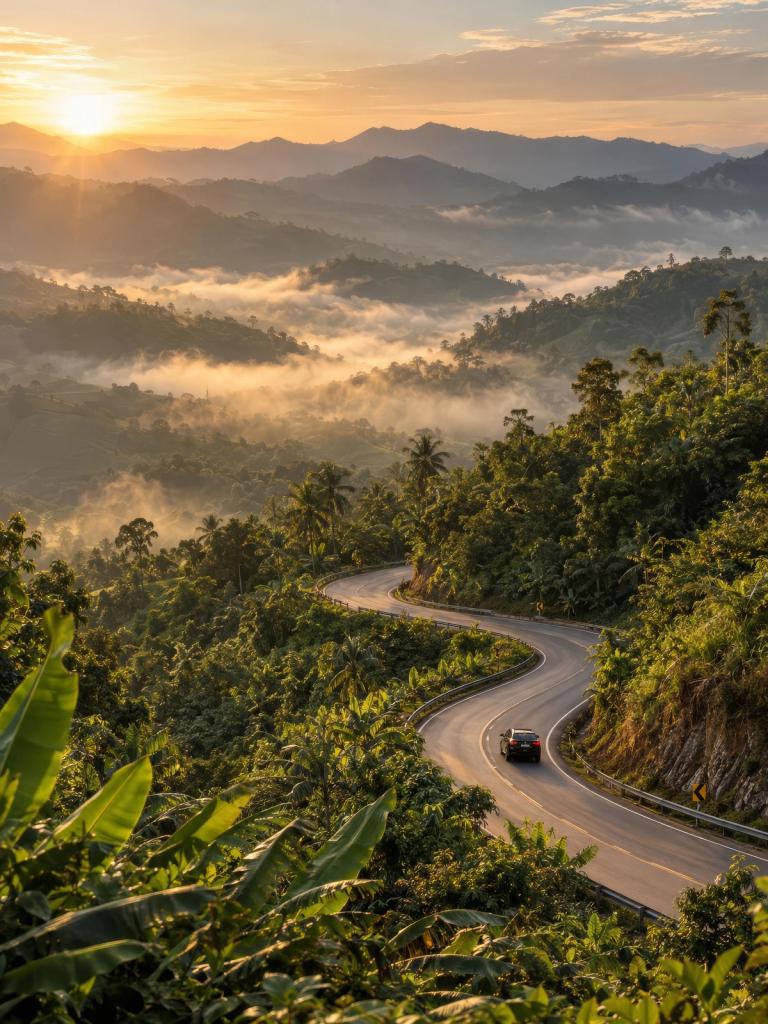
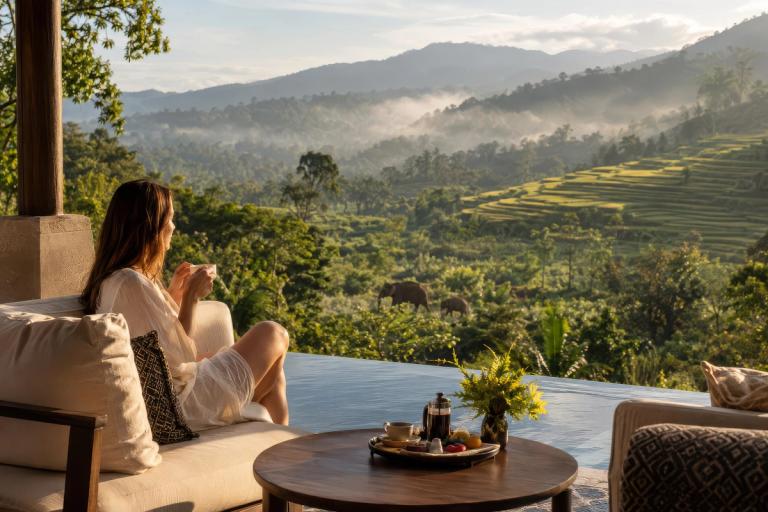
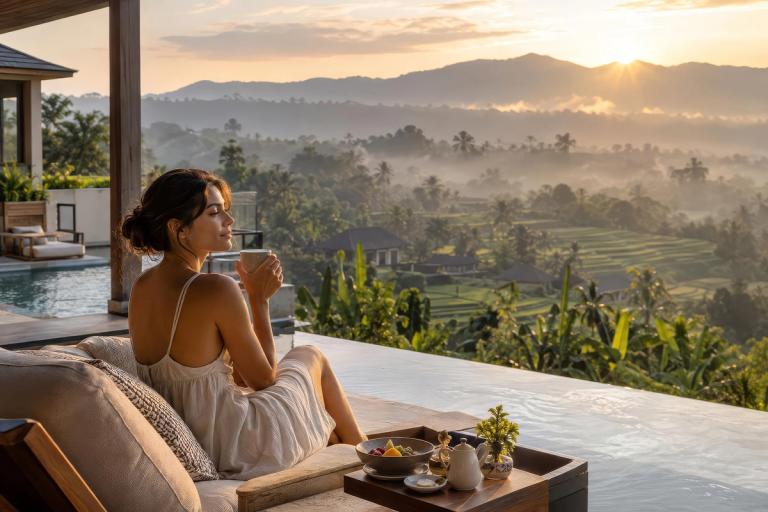
You wake to mist over the rice fields, mountains on every side and nothing planned until lunch. That is Pai. It is popular for its setting and its pace. A wide green valley sits between forested mountains, with rice fields, small farms and a slow river. Add a sunset canyon, natural hot springs, waterfalls and cool mornings, and the place is easy to love.
The town grew famous in the 2000s as a stop for young visitors. Guesthouses, cafés and small bars followed, and its name spread from one visitor to the next.
Today Pai has two faces. In the centre, a small grid of streets fills with cafés, shops and an evening market. Outside the town, the valley is quiet, with farmland, temples on the hills, small resorts and long views. Our advice: spend your time in the second Pai.
You drive a few minutes and you are among hills with no buildings in sight.
The people of the valley add to its character. Pai district is home to Thai, Shan and hill communities, and to a Chinese Yunnanese village on the hill above town. A good guide helps you understand what you are looking at.
Pai is not a luxury destination in the way Phuket or Koh Samui are. There is one small resort we recommend, and service elsewhere is simple. Go for the scenery and the drive, and plan your stay with care.
Is Pai worth visiting?
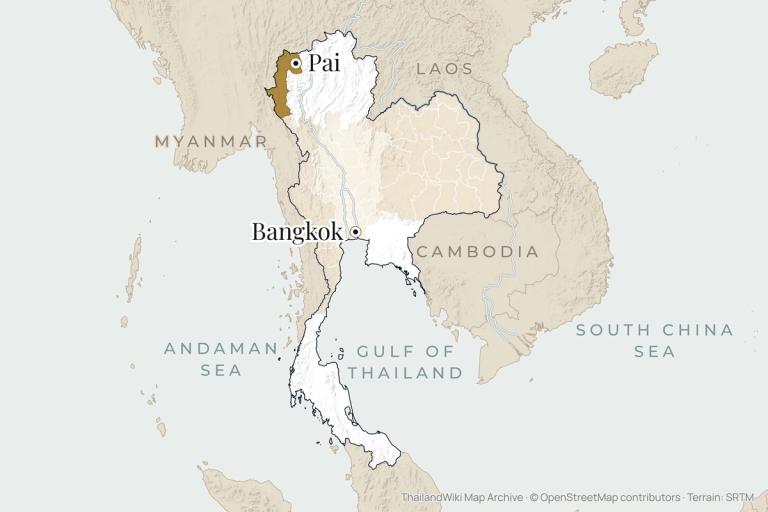
Yes, as part of a northern road trip. Pai is worth one or two nights on a private-driver journey from Chiang Mai, or on the full Mae Hong Son loop. It is not worth a long detour on a short trip to Thailand, because the road is slow and the town is simple.
The case for going is simple. The valley is one of the prettiest in the north. The drive over the mountains is part of the experience with a good driver and a comfortable car. And Pai gives you a slower, rural side of Thailand that is easy to miss.
The case against is just as clear. The road is winding, and you may feel car-sick. Luxury hotels are almost absent, and the town centre can feel crowded in high season.
If you have five or more days in the north and enjoy landscapes, add it. If you have three days in Chiang Mai, stay there and see temples, food and the mountains nearby instead.
Chiang Rai has the famous White Temple, more hotels and its own airport. If you have to choose one extra stop beyond Chiang Mai, Chiang Rai is easier.
Health care is simple in Pai, so plan with care if anyone in your group has a medical condition. The nearest international hospitals are in Chiang Mai: Bangkok Hospital Chiang Mai and Chiangmai Ram Hospital, both accredited by the Joint Commission International. Bring any medicines you need for the whole trip.
A day trip from Chiang Mai is possible but long; one night in Pai, with sunset at the canyon and a dawn viewpoint, is better.
Who is Pai best for?
Pai is best for couples and families on a slow northern trip, and for photographers. It also suits you if you like nature and quiet more than shopping and nightlife. It suits people who enjoy a road journey and simple, honest food. It does not suit you if you need full five-star service every day.
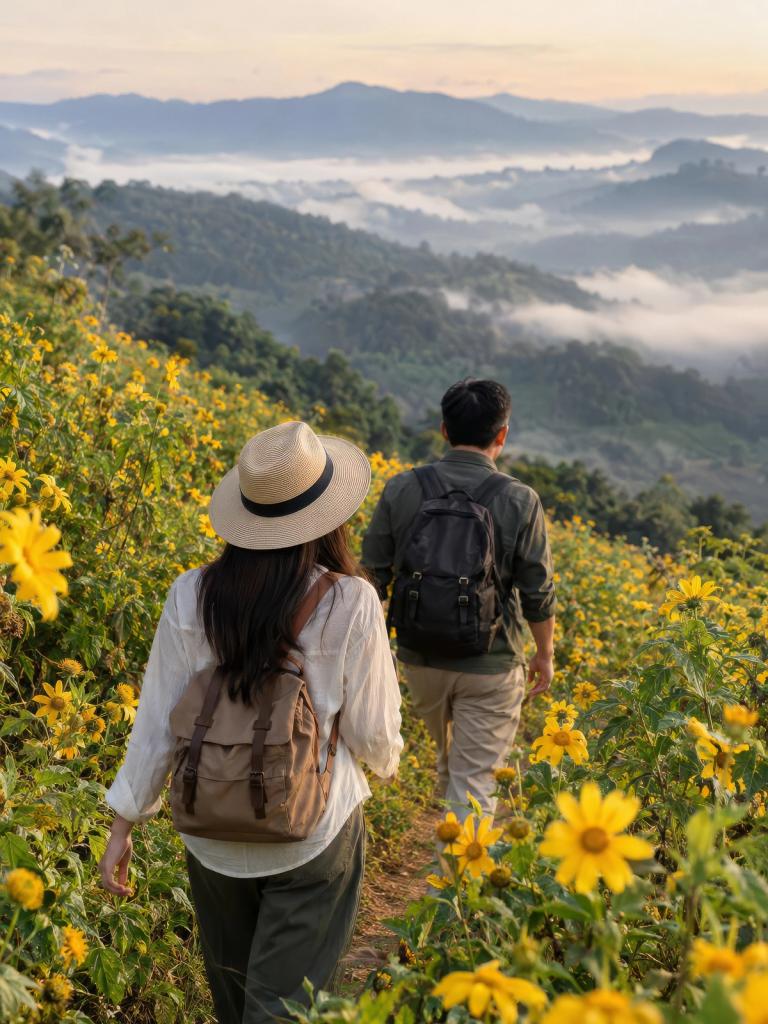
Couples enjoy the sunsets, the misty mornings and the feeling of being far from cities. Families with older children like the canyon, the waterfalls and the hot springs.
Grandparents can rest at the resort while younger family members walk the canyon at sunset.
Sunrise over a sea of mist, a picnic by a waterfall and a quiet dinner under the stars are easy to arrange.
Small teams on a retreat also use Pai well. A private villa becomes a base for quiet workshops in the morning and walks or hot springs in the afternoon. The distance from the city helps people switch off and talk.
If you want spas, fine dining and polished service, plan just one night here.
Is Pai a party town, and is it full of tourists?
Pai has a lively side, but we do not plan it as a party town. A few bars on and around the main Walking Street play music late, mostly for a young crowd. The town centre is busy in December and January. Outside the centre, the valley stays calm and quiet at night.
The centre is small, so its evening market and bars can feel crowded in the cool season. The crowd there is mostly young people from Europe, Asia and Australia, plus Thai visitors who come for the cool weather and the views.
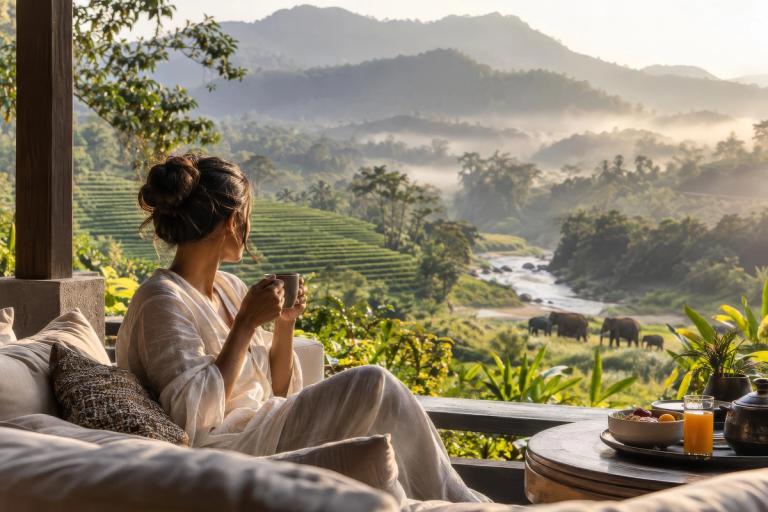
If you want peace, stay outside the town and visit the centre for an early evening walk. Your nights will be dark, cool and silent, with stars over the valley.
Crowds also gather at the best-known viewpoints at sunset and sunrise. A good guide knows quieter spots and the right times to arrive. With a private driver, you can leave before the crowds and avoid the queues on narrow roads.
For a calm evening, the best plan is simple. Watch the sunset at the canyon or the white Buddha, and eat an early dinner. Then return to your resort for a fire, a glass of wine and the stars.
For a polished night out in the north, Chiang Mai has rooftop bars, fine dining and live music in a more refined setting.
Where should you stay in Pai?
Reverie Siam is the stay we recommend in Pai. It is a small boutique resort in Vieng Tai, close to the town yet set in a quiet garden by the river. Luxury options in Pai are few, and we say so honestly. For larger groups, a private villa in the valley is the other good choice.
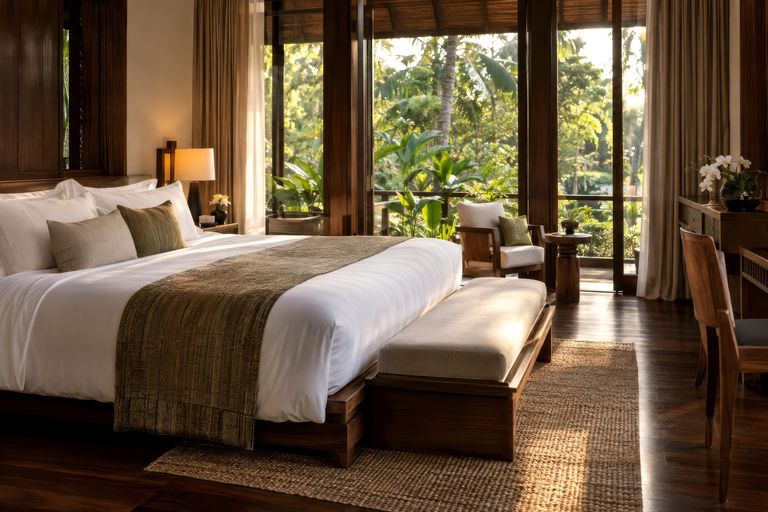
Reverie Siam Resort. This is the only stay in Pai that we class as luxury boutique. It has a small number of rooms, a pool, a garden and a restaurant, with a calm, old-world style. Because it is small, it books up early for December and January.
A private valley villa. A villa outside the town gives a family or friends space and privacy. Picture a four-bedroom house in the fields with a pool, mountain views and a cook. We describe each villa to you and arrange staff and transport.
What to expect from other hotels. Most other places to stay in Pai are guesthouses, small resorts and bungalows. Many are pleasant, but they are not luxury. Rooms can be simple, and service is relaxed.
Our planning tip. If Reverie Siam is full, consider spending only one night in Pai and two in Chiang Mai or Mae Hong Son instead. You still see the valley at its best, at sunset and at dawn, without compromising your stay.
How long to stay. One night is enough to see the canyon at sunset and the valley at dawn.
What to pack. Bring layers: light clothes for warm days, a fleece or jacket for cold mornings, and comfortable shoes with grip for the canyon and waterfall paths. Pack insect repellent, a hat and a small torch for early starts.
Ask for extra blankets, and bring a warm layer for early starts to the viewpoints.
What can you do in Pai?
The best things to do in Pai start with the canyon at sunset, the hot springs and Pam Bok waterfall. Add the Land Split and the bamboo bridge across the rice fields at dawn. Finish with the Yun Lai viewpoint at sunrise and the white Buddha above the town. With a driver, you can see them all in one full day.
Pai Canyon (Kong Lan). Narrow red-earth ridges drop away on both sides into a forested gorge. The Tourism Authority of Thailand places it at around kilometre 90 on Route 1095. Come for sunset, wear shoes with good grip and keep children close; the paths are narrow with no rails.
Tha Pai hot springs. Natural hot water flows through a forest stream into warm pools. Go in the early morning on a cold day, when steam rises from the water.
Pam Bok waterfall. A short walk leads to a waterfall between high rock walls. It is cool and shaded, and best after the rains, from about September to December.
The Land Split. On a farm outside town, the ground cracked open after an earthquake. The family who own it welcome visitors and serve fruit and juice from their land. It is a simple, friendly stop.
The bamboo bridge. A long bamboo walkway crosses the rice fields to a forest temple. At dawn, with mist on the fields and monks walking, it is one of the most peaceful scenes in northern Thailand. Go before the day visitors arrive.
Yun Lai viewpoint. This hill above a Chinese village gives the best sunrise view over the valley. Leave your hotel before first light.
The white Buddha. A large white Buddha sits on a hill east of the town, at Wat Phra That Mae Yen. A long stairway leads up to it. The view at sunset is wide and calm.
Huai Nam Dang viewpoint. On the drive from Chiang Mai, a high viewpoint in Huai Nam Dang National Park looks over ridge after ridge of mountains. On cool-season mornings, the valleys fill with mist below you. It is worth an early start from Chiang Mai.
The Chinese village. Below Yun Lai, a village founded by Chinese Yunnanese settlers has tea shops, a small market and Chinese-style houses.
Mor Paeng waterfall. West of town, this small waterfall has smooth rocks and shallow pools. In the dry season, children enjoy sliding into the water.
Coffee and farm visits. Small coffee and fruit farms in the hills welcome visitors. A guided visit shows how beans are picked, dried and roasted, and ends with a tasting on a terrace.
Cooking class. A private class with a local cook teaches you northern dishes such as khao soi. You shop at the market first, then cook and eat together.
A slow afternoon. Leave space in the day for nothing at all. Read on your terrace, swim, or take a short walk along the river with your guide. The valley is at its quietest in the early afternoon, and that calm is one of the reasons to come.
Photography tips. The best light in Pai comes in the first and last hour of the day. Mist forms on clear, cold nights, so the morning after a starry evening is the one to get up early for. Your guide checks the sky the night before and tells you if it is worth the alarm.
Respect at temples. Cover shoulders and knees, remove your shoes where asked, and keep your voice low. Ask before photographing monks.
A word on scooters. Many young visitors rent scooters in Pai. The mountain roads are steep and winding, and accidents are common. We plan every outing with a car and a local driver who knows the roads.
How do you plan the northern mountain loop with Pai?
Plan the loop as a private road trip of five to seven days. Drive Chiang Mai to Pai, then Pai to Mae Hong Son. Continue to Mae Sariang, then back to Chiang Mai. The Tourism Authority of Thailand puts the full loop at about 600 km. Spend one or two nights at each stop. Example plan: seven days around Pai.
Day 1: Chiang Mai to Pai. Leave after breakfast and stop at viewpoints and a mountain café on the way.
Day 2: Pai. Sunrise at Yun Lai, the bamboo bridge, the hot springs and a slow afternoon at your resort.
Day 3: Pai to Mae Hong Son. Highway 1095 continues over the mountains to Mae Hong Son, the TAT confirms. Stop at Tham Lod cave on the way, and arrive in Mae Hong Son for the evening lake walk.
Day 4: Mae Hong Son. Sunrise at Doi Kong Mu, the lake temples, the Pang Ung reservoir and a tea village near the border.
Day 5: Mae Hong Son to Mae Sariang. A quieter road south through forests and Karen villages, with a night by the river in Mae Sariang.
Day 6: back to Chiang Mai. Return through the mountains, with a stop at Doi Inthanon if the weather is clear.
Day 7: Chiang Mai. End with a rest day at a Chiang Mai resort: a spa, a long lunch and an evening at a rooftop bar before your flight.
A shorter version. With only three days, drive from Chiang Mai to Pai and spend one full day there. Continue to Mae Hong Son, and return to Chiang Mai by car on the third day. It is a lot of driving, so we suggest it only if you enjoy the road.
Which direction? Drive clockwise, through Pai first. The road from Chiang Mai to Pai is the busiest stretch, and doing it first means a fresh start.
The road is the main event. The TAT counts 1,864 curves between Chiang Mai and Mae Hong Son. One planner sets short driving days, the rooms and the guides for the whole loop, with our Thai team on call. You need a comfortable car and an experienced driver, and our luxury chauffeur service provides both. For the next stop, read our Mae Hong Son guide.
Where should you eat in Pai?
For the best meal in Pai, eat at your resort or try northern Thai food in the town. The evening Walking Street market is good for a light, casual dinner. Valley cafés serve excellent coffee and breakfasts with mountain views. Pai has no fine dining, so keep meals simple and local.
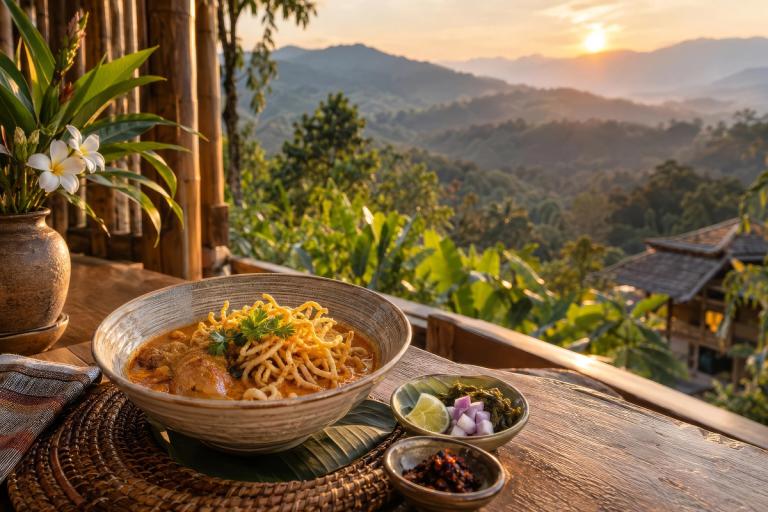
Northern Thai food. Look for khao soi, the curry noodle soup of the north, and nam prik ong, a mild tomato and pork dip with vegetables. Sai ua, the herb sausage of the north, is good with sticky rice. Ask your guide to take you to a family kitchen in town.
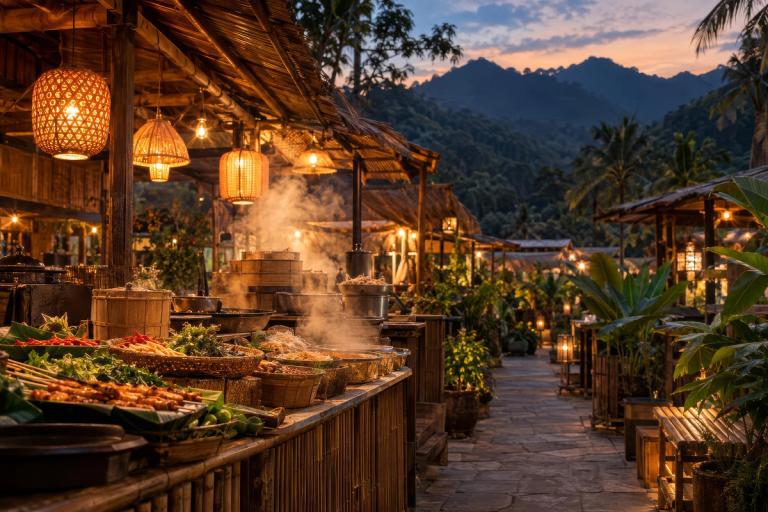
The evening market. The main street becomes a food market at dusk, with grilled meats, noodles, fruit and sweets. Go early in the evening before it fills, and eat with your guide so you know what to try.
Valley cafés. Coffee is grown in the hills of northern Thailand, and Pai's cafés take it seriously. A morning coffee with mist on the fields is one of the best moments of a stay.
Wine and drinks. Pai has a few relaxed bars and cafés that serve wine and cocktails, but choice is limited.
Resort dining. Your resort restaurant will be the calmest place for dinner, with Thai and Western dishes and a good wine list in season.
Chinese Yunnanese dishes. The village near Yun Lai serves Yunnanese food: braised pork with steamed buns, mushroom dishes and noodles. It makes a good late breakfast after sunrise.
A picnic by the river. Ask your resort to pack a picnic, and your driver to take you to a quiet spot by the river or the fields. It is one of the nicest ways to spend a warm afternoon.
Halal and vegetarian food. Vegetarian meals are easy to find in Pai. Halal kitchens are rare, so we arrange halal meals in advance.
When is the best time to visit Pai?
The best time to visit Pai is November to February. The air is cool and clear, the valley is green after the rains, and mornings bring mist over the fields. In the Thai Meteorological Department's normals for northern Thailand, December and January are the driest months, with about 11 mm of rain each.
December and January bring cold mornings and nights. Pack a warm jacket and a scarf for the sunrise viewpoints.
Smoke from forest and farm fires fills the valleys. Pollution Control Department data showed a 24-hour PM2.5 reading of 317.8 µg/m³ in Pai on 2 April 2026. We do not recommend Pai in March and early April.
The rainy season runs from about June to October. September is the wettest month in the north, with about 222 mm in the same normals. The valley is lush, waterfalls are full, and roads can be slippery. Some days are clear and beautiful.
The busiest days are around New Year, when many Thai visitors drive up for the cold weather. Roads, viewpoints and the town centre fill. Book the resort and your driver early for that week, and plan sightseeing for early mornings.
Rain clears the air, and October and November are often the best months for colour. The fields turn gold, the waterfalls are full and the sky is clear after the storms.
May is hot, and the first storms arrive at the end of the month. Fields are being prepared for planting, and the valley is calm.
- November to February: best, cool and dry
- February to April: haze season, poor air at times
- May: hot, with the first storms
- June to October: green and wet, quiet
How do you get to Pai?
You reach Pai by road from Chiang Mai, as Pai airport has no scheduled flights. From Chiang Mai International Airport, the drive takes about 3 hours by car (checked November 2026).
By private car. This is the comfortable way. Allow a full morning, with breaks.
By minivan. Public minivans run between Chiang Mai and Pai. They are cramped, and the speed on the curves is hard for many people. We do not recommend them.
By air. There are no scheduled flights to Pai. Flying into Chiang Mai International Airport is the start of every trip to the valley. Private charter options to Pai airport are possible only by special arrangement; ask us before you plan around one.
From Bangkok. Fly from Bangkok to Chiang Mai, spend a night there, and drive to Pai the next morning.
Luggage. Pack for the road. One medium suitcase per person fits comfortably in a large car with room to stretch. Keep a small bag with water, a jacket and medication within reach.
Motion sickness. The road has many curves. Eat a light breakfast, sit in the front or the middle row and look at the horizon. Take a motion-sickness tablet before you leave if you need one.
On to Mae Hong Son. From Pai, the road continues west over more mountains to Mae Hong Son. This is the classic loop route. You can return to Chiang Mai from Mae Hong Son by the southern road through Mae Sariang.
Safety on the road. In the rainy season, landslides and slippery stretches are possible. In the haze season, visibility can drop. An experienced local driver adjusts the plan to the conditions.
Timing your departure. Leave Chiang Mai after breakfast, around 09:00, to arrive in Pai for lunch. Avoid driving the mountain road after dark.
Our Chiang Mai to Pai route guide has more detail on the drive, and our Chiang Mai guide covers where to stay before and after.
Plan Pai with Tanner
Tanner plans Pai as one stage of a northern road trip. That means the car and driver from Chiang Mai, the right room at Reverie Siam, and a dawn viewpoint when mist is forecast. One planner holds every piece, for a couple or three generations, and our Thai team checks the roads and the air each morning. If the haze in March would spoil the valley, we tell you and suggest other dates. Send your dates and party size, and you get one written plan with every price included.