Can foreigners buy property in Thailand?
You have found a sea-view condo, and the agent asks for a deposit today. These are the rules to check before you pay.
Yes, but only certain kinds. You can own a condominium unit freehold, in your own name, under the Condominium Act. You cannot own land in your own name under the Land Code. You can lease land, own a building on leased land, or use one of a few narrow legal routes.
The list below shows what you can and cannot hold, with the law behind each line. It covers private buyers. Companies with Board of Investment promotion follow other rules; a licensed Thai lawyer explains them.
- Condominium unit: yes, freehold in your own name, within the 49% foreign quota of the building (Condominium Act B.E. 2522, section 19 bis).
- Land: no ownership in your own name (Land Code). The Department of Lands notes that the treaty route in section 86 has had no treaty in force since 27 February 1971.
- Land lease: yes, registered at the Land Office for up to 30 years per term (Civil and Commercial Code, section 540).
- A house or villa on leased land: yes, you can own the building itself, separate from the land.
- Land through a large investment: possible, up to 1 rai for a home, under Land Code section 96 bis (see below).
- Land held by a Thai nominee for you: no. This is illegal.
So most foreign buyers take one of two routes. A condo in their own name, or a lease on the land under a villa with the house owned on top. Both are legal and common. Everything else needs careful legal advice.
Choose your own lawyer before you choose the property. An agent is paid by the sale, and a developer's lawyer works for the developer. A licensed Thai lawyer who works only for you checks the title, reads the contract and goes to the Land Office with you. Get the fee in writing at the start.
Buying a condo: the 49% foreign quota
The 49% foreign quota caps foreign ownership in each condominium building. Foreigners together may own no more than 49% of the total floor area of all units (Condominium Act, section 19 bis). Once the foreign share is full, the next foreign buyer cannot register a unit, even if one is for sale.
The quota counts floor area, not units. A building of small units may still have quota left for a large penthouse, or the other way round. The share moves every time a foreigner buys or sells.
Ask before you pay any deposit. The juristic person, the legal body that runs the building, keeps the register of foreign ownership. Your lawyer asks it for a letter confirming the quota left. The Land Office checks the same figure on transfer day.
In a new development, the developer sells some units to foreign buyers and some to Thai buyers. Ask for the foreign-quota units by number, and have your lawyer write that unit number into the contract. A unit sold as 'Thai quota' cannot be registered to you.
The money rule matters as much as the quota. Under section 19 of the Condominium Act, a foreign buyer brings the purchase money into Thailand in foreign currency. Send it from your own account abroad to a Thai bank account, and let the Thai bank change it into baht.
The receiving bank then gives you a document that proves the foreign-currency transfer. For a transfer of US$50,000 or more, this is a Foreign Exchange Transaction (FET) form; below that, the bank gives a confirmation letter (The Thaiger property guide, updated 26 August 2026). The Land Office asks for this proof before it registers the unit, so ask your lawyer which document your Land Office accepts.
Keep that bank document safe. It is also your proof when you later sell and send the money home. If you bring cash instead, declare foreign currency above USD 15,000 to Thai Customs on arrival.
Off-plan or finished? A finished resale unit shows you the view, the noise and the building's upkeep before you pay. An off-plan unit is paid in stages during the build, so the foreign-currency proof must cover every stage. Have your lawyer check that each payment is recorded against your unit.
Every condo building has its own rules, set by the juristic person and the owners. They cover common fees, pets, renovations, short lets and shared areas. New owners pay a one-off sinking fund contribution at transfer, then a monthly common fee. Ask for the latest accounts: they show whether the building is well run.

Land and houses: leases and other structures
For a villa or a house with land, the legal route for a foreign buyer is a registered land lease. Under section 540 of the Civil and Commercial Code, a land lease runs up to 30 years per term. The Department of Lands cuts any longer term down to 30 years.
Register the lease at the Land Office, so it is recorded on the land title deed. A lease signed between two people and never registered gives you far weaker protection.
Many leases include an option to renew for further terms. That option is a contract term between you and the landowner. The law does not guarantee it, and it can be hard to enforce. Do not pay for 60 or 90 years if only 30 are registered.
You can own the house itself while you lease the land under it. Your lawyer records your ownership of the building separately from the land, so the house is clearly yours.
Two other rights in the Civil and Commercial Code come up often. A usufruct gives you the right to use land and take its income. A superficies gives you the right to own buildings on it. Both are registered at the Land Office, and each has its own limits on length.
These rights help, but they do not make you the landowner. Have your lawyer explain what happens to each right if the landowner dies, if the land is sold, and on your own death.
Before you sign a lease, have your lawyer check five points. Is the full term registered? Is the rent for the whole term paid at once, with the receipt recorded? Can you pass the lease to a buyer or your heirs? Can you sublet? What happens to the house when the lease ends?

Thai companies and nominees: what is illegal
Using a Thai person or company as a nominee to hold land for you is illegal. Section 36 of the Foreign Business Act B.E. 2542 punishes the Thai who holds shares for a foreigner, and the foreigner who allows it. The penalty is up to 3 years in prison, a fine of ฿100,000 to ฿1,000,000, or both.
The usual nominee set-up is a Thai company where Thai shareholders hold the majority on paper and the foreign buyer pays for everything. The company then buys the land. Officials can look at who really paid and who really controls the company.
On conviction, section 36 also tells the court to order the nominee shareholding to end. You can lose control of the property and the money you paid. A clean lease or a condo in your own name takes longer to set up, and it is far safer.
Walk away from any agent who sells 'land in your own company' as a simple product. Have a licensed Thai lawyer who works for you, not the seller, explain the risks in writing.
Legal routes give most buyers what they want. A long registered lease with the house in your own name gives secure use of a villa. A condo gives full ownership. A company with real Thai partners and real business is a separate matter for business owners, with its own legal advice.
The BOI investment route to land
Section 96 bis of the Land Code lets a foreigner own land for a home after a large investment in Thailand. The Department of Lands sets out the rule: invest at least ฿40 million in an approved type of investment. With the Minister's permission, you may then hold up to 1 rai of land as your home.
The investment must stay in place for the period the rule sets, and the land may be used only as your home. The Department of Lands publishes the full conditions.
This route suits very few buyers. It ties up a large sum, approval takes time, and the land is for one home only. For most families a condo or a lease does the same job for far less. Ask a licensed Thai lawyer whether it fits your case.
It can suit a family already planning a large, long-term investment in Thailand that wants one home on its own land. Even then, compare it with a long lease on a better plot. The lease may give you more choice of location.
What does it cost to buy?
Buying property in Thailand costs a transfer fee of 2% of the official appraised value, plus taxes that depend on the seller. The Department of Lands lists each charge. Who pays what is agreed in the sale contract, so read that clause before you sign.
These are the main charges at the Land Office, as the Department of Lands lists them:
- Transfer fee: 2% of the appraised value set by the official valuation committee. This applies to land and to condominium units.
- Specific business tax: 3.3% of the appraised value or the sale price, whichever is higher. It applies when the seller sells within 5 years of buying, with some exceptions.
- Stamp duty: ฿1 for every ฿200 of the price, which is 0.5%. It applies only when specific business tax does not.
- Withholding income tax: paid by the seller. A company seller pays 1% of the higher of the price or the appraised value. A private seller pays tax on a scale that depends on the years held.
- Mortgage registration: 1% of the loan, up to ฿200,000, if you register a mortgage.
A simple example with the transfer fee alone. On a condo with an official appraised value of ฿20 million, the 2% transfer fee is ฿400,000. The appraised value is often below the market price, so get the official figure from the Land Office or your lawyer first.
In most sales the seller pays the taxes, because they are taxes on the sale. The transfer fee is often split, but that is a contract term, not a rule. On a new condo, the developer's contract sets the split, and it can differ from a resale.
Your own costs come on top: the lawyer's fee, the bank's charges for the foreign-currency transfer, and the building's sinking fund and service charges. Get every figure in writing before you agree the price.
Compare two homes on full cost, not asking price. One seller may quote a price that includes the transfer fee and the furniture; another quotes a bare price. Ask each seller for a written list of what the price covers and who pays each charge.
How does a property purchase in Thailand work, step by step?
A purchase in Thailand runs in a clear order: reservation, legal checks, sale contract, money transfer, and transfer at the Land Office. Most delays come from the checks and the foreign-currency transfer. A licensed Thai lawyer who works only for you should lead every step after the first viewing.
Do not sign anything in Thai that you cannot read.
Ask for the contract in English as well as Thai, and agree which language wins if they differ. Check that the unit number, floor area, parking space and any furniture are listed. If the seller still owes a bank, the contract should say how that loan is cleared on transfer day.
A land lease follows similar steps. The lease is registered on the land title deed, and the house is registered separately in your name. Your lawyer also checks the access road. Land with no legal access is hard to use or sell.
Not in Thailand on transfer day? Sign a power of attorney so your lawyer attends for you. Use the Land Office's own form, and have your signature certified as the Land Office requires. For a new condo, book an inspection of the finished unit before transfer. List every defect in writing and have the developer fix them first.
Sources for these steps: the Department of Lands, the Condominium Act B.E. 2522 and the Bank of Thailand's foreign-exchange rules. Checked 6 November 2026.
Is it worth buying a property in Thailand?
It can be, if you buy for your own use and accept the limits. A home in Bangkok or Phuket gives you a base for long stays and a place for family. As a pure profit play it is weaker, because resale depends on the foreign quota and on finding a buyer.
Start with how you will use it. A few weeks a year? A hotel or a rented villa may cost less and give more choice. Months at a time? Owning a condo can make sense.
City or island? A Bangkok condo suits families with business, schools or hospitals in the city, and you lock it and leave. An island villa suits slower stays with family and friends. It needs staff, upkeep and someone to look after it while you are away.
Think about selling too. A foreign-quota condo can only be sold to a foreigner as freehold while quota remains. Leases lose value as the years run down. We give no investment advice: talk to your own adviser before you buy.
Plan the exit on the day you buy. When you sell, the bank document from your purchase shows the money first came in from abroad. Keep it with your title deed, contract and every tax receipt. Your bank asks for these papers before it sends sale money out of Thailand.
Daily living costs are a separate question from the purchase. Budget for building fees, staff, utilities and insurance every year, as well as the price.
Settle the rental question early. Plan to let the home while you are away? Ask your lawyer about tax on rent and about any building rules on short stays. Many condo buildings limit short lets, so read their rules before you buy.

Branded residences and serviced homes
Branded residences are homes in a building or estate run under a hotel brand, popular with foreign buyers in Bangkok and Phuket. You own a condo unit or lease a villa in the normal legal way. The hotel company manages the building and provides its services.
The legal rules above still apply. A branded condo is still subject to the 49% quota and the foreign-currency rule. A branded villa on land is still a lease for foreign buyers.
Before you buy, read the management agreement between the owners and the hotel operator. Check the yearly fees, what they cover, how long the agreement runs and what happens if the brand leaves. With a rental programme, ask how income is shared and how many nights you can use the home yourself.
Stay at the brand's hotel nearby for a night or two, if it has one. The hotel's service is the best guide to the service you get at home. Ask current owners how quickly the management team answers them.
Our guide to branded residences covers the main projects and what to check.
Property and visas
Buying property in Thailand gives you no visa and no right to stay. The long-stay routes are separate. The Long-Term Resident (LTR) visa gives 10 years, multiple entry, for ฿50,000 per person when collected in Thailand. Thailand Privilege membership starts at ฿900,000 for Gold, which lasts 5 years.
The Board of Investment runs the LTR visa. It has four categories: Wealthy Global Citizens, Wealthy Pensioners, Work-from-Thailand Professionals and Highly-Skilled Professionals. Our LTR visa guide explains who qualifies.
Thailand Privilege, formerly Thailand Elite, sells memberships with long-stay visas. Gold costs ฿900,000 for 5 years and Platinum ฿1,500,000 for 10 years. Diamond ฿2,500,000 for 15 years and Reserve ฿5,000,000 for 20 years or more, by invitation. See our Thailand Privilege guide.
Neither the LTR visa nor Thailand Privilege gives you any right to own land. They let you stay; the property rules stay the same.
Long stays also raise tax questions. The Revenue Department treats anyone in Thailand 180 days or more in a tax year as tax resident. Under its 2024 rule, a resident pays Thai tax on foreign income earned from 1 January 2024 when it is brought in. Plan the purchase money with a tax adviser, so you know which funds are which.
Where foreigners buy
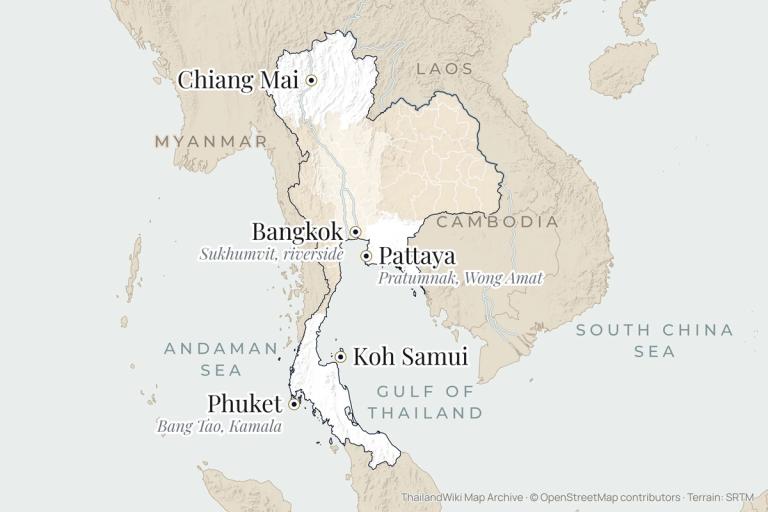
Most foreign buyers choose Bangkok, Phuket, Koh Samui, Pattaya or Chiang Mai. Each market has its own mix. Bangkok is mostly condos. Phuket and Koh Samui are known for villas on leased land and resort condos. Pattaya and Chiang Mai have both.
Bangkok. Buyers look at Sukhumvit, the riverside and the central business district. Most homes are condos in high-rise buildings with hotel-style services. See property in Bangkok.
Phuket. The west coast draws most villa buyers, with Bang Tao and Kamala among the main areas. Many projects come with resort services. See property in Phuket.
Koh Samui. Sea-view villas on hillsides and beachfront plots are the main market. Leases are the usual route for foreign buyers. See property on Koh Samui.
Pattaya. Pratumnak Hill and Wong Amat are the quieter areas for condos by the sea, within easy reach of Bangkok.
Chiang Mai. Buyers come for a cooler climate in the cool season and a slower pace. Condos near the city and houses on leased land are both common.
Whatever the city, visit in both seasons if you can. A villa that looks perfect in the dry season may face heavy rain, a steep road or building work next door at other times. Spend a few nights in the area first, and walk the street at night as well as by day.
Recent changes
The core rules did not change in 2026. The 49% condo quota and the 30-year lease term are still the law. The Department of Lands lease guide of March 2026 repeats the 30-year cap. Ideas for a higher condo quota or longer leases have been discussed, but no change has been published in the Royal Gazette (checked November 2026).
Do not buy on the promise of a future change. If a seller offers a '90-year' or '99-year' lease, only the first 30 years can be registered. VAT stays at 7% until 30 September 2027 under Royal Decree No. 807. It applies to services you buy, such as legal fees.
We re-check these rules regularly and update this page when the law changes.
For 2027 we watch three things. Any bill to change the condo quota. Any change to the lease term in the Civil and Commercial Code. Any new transfer-fee measure. Each would appear first in the Royal Gazette.
Buy with a local partner
Tanner, your planner, books the viewing trip, so your time goes to the homes. We can introduce a trusted agent and a separate lawyer who works only for you. We handle your stay, flights and drivers while you look. We do not give legal or investment advice.
Our relocation services cover the rest of the move: schools, banking introductions and settling in. Tell us the city, the budget and your timing. We get back to you right away.
A viewing trip is a few days in one city. We book your hotel, flights and a car with a driver; the agent arranges the viewings. You leave with notes, photos and, from your lawyer, the next steps in writing.