0 of 6 ready
What do I need for a destination wedding in Thailand?
You have a month in mind, a rough guest list and a coast you like. This checklist turns those three things into a wedding week. One question few couples ask in time: many Thai beaches are public, so how will the resort keep your ceremony private?
You need five things. Start with a date in the right season, a venue that fits your guest list and a clear plan for the legal marriage. Add travel and rooms for your guests, and one planner in Thailand. Everything else on this destination wedding checklist hangs from those five decisions.
- The date. Thailand has two coasts with different rainy seasons, and five Buddhist holy days with alcohol limits. Pick the coast and the date together.
- The venue. A Bangkok ballroom, a resort beach or a private villa. Capacity decides more than style.
- The legal plan. Register in Thailand at a district office, or marry legally at home and hold the ceremony here.
- Guest travel. Flights, entry rules, room blocks and transfers for everyone you invite.
- One planner. A single person who holds every supplier, every timing and every guest question.
The last point is the one that decides the week. A wedding in Thailand means a venue team, a florist, a photographer, musicians, boats, cars and a hotel front desk. All of them work in Thai and English. One person must own the timeline and speak for you on the day.
For ideas on where to marry and what a Thai wedding can include, start with our guide to the destination wedding in Thailand. This page is the working checklist, month by month.
Be honest about your guests before you commit. A destination wedding asks people to take leave, fly and spend several nights away. Older relatives may need help with long flights and heat. Close friends with young children may come for three nights, not five. Plan the programme so that everyone can enjoy the parts they choose to attend.
The reward is a wedding that feels like a holiday shared with the people you love most. Your guests spend real days together, not one evening. Keep the free day by the sea in the plan.
12 to 9 months out
Twelve to nine months before the wedding, fix the four big choices: the season, the coast, the venue and the size of the guest list. The best venues in high season are booked a year ahead, and every later decision depends on these. Send save-the-dates as soon as the venue is confirmed.
- Choose the coast and month together (see the season section below).
- Check the date against the 2027 Buddhist holy days and Thai public holidays.
- Draft the guest list in three groups: certain, likely and hoped-for.
- Shortlist three venues that fit the likely number, not the hoped-for one.
- Visit the venues, or send someone you trust to walk them for you.
- Appoint your planner and agree how decisions will be made.
- Decide the legal route: register in Thailand or marry at home first.
- Set the budget by priority: venue and guests first, then the extras.
- Book the photographer and videographer early; the best ones fill fast.
- Send save-the-dates with the coast, the month and the wedding website.
A word on the budget. Some planners use simple formulas to split spending between the venue, food and the rest. They help at home but fit a destination wedding less well, because guest travel and several days of hosting change the shape of the budget. Start from your guest list and the number of days you will host.
Think about how many days the celebration lasts. Many Thailand weddings run over three or four days: a welcome evening, a free day, the wedding and a farewell brunch. Decide this now, because it sets the room block and the number of events to plan.
Set up a simple wedding website at this stage. Put the dates, the coast, the venue name, the nearest airport and a promise of travel details to come. Guests use it to request leave and look at flights, so the earlier it exists, the more guests can come.
Read every venue contract slowly. Check the deposit schedule, the cancellation terms, the minimum spend and what happens if the hotel changes owner or closes for renovation. Ask for the room-block terms in the same contract, so the rooms and the events are tied together.
Choosing a venue: beach, villa or ballroom
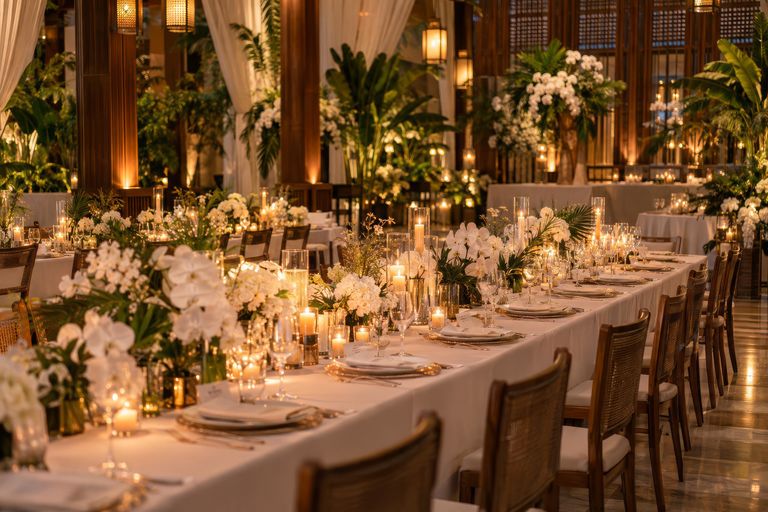
Choose the venue by guest count first and style second. Bangkok ballrooms take several hundred guests, beach resorts suit 30 to 150, and private villas suit smaller weddings. The capacities below come from each hotel's own wedding pages, checked in October 2026; confirm them for your layout.
Large weddings in Bangkok. Siam Kempinski Hotel Bangkok says its pillarless Chadra Ballroom takes up to 1,200 guests cocktail-style. Mandarin Oriental, Bangkok's Royal Ballroom takes up to 800, and its Authors' Lounge hosts smaller weddings. The Sukhothai Bangkok's garden holds 600 to 800 guests and its ballroom 300. For the largest guest lists, our pick is the Chadra Ballroom.
Waldorf Astoria Bangkok's Magnolia Ballroom takes up to 700 guests for receptions. Park Hyatt Bangkok offers a ballroom for up to 600 guests and a wedding salon, with cocktail receptions for up to 700. Bangkok suits families with many guests, older relatives and business friends.
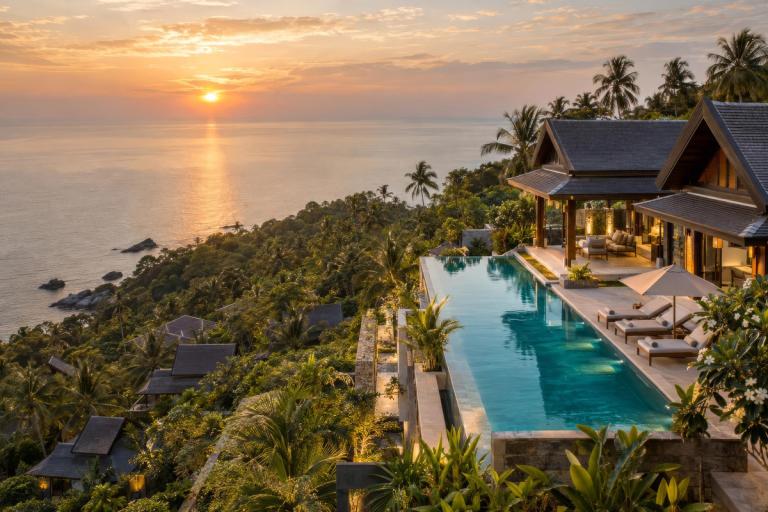
Beach and resort weddings. In Phuket, Sri Panwa says its largest ballroom takes up to 400 guests and it also hosts weddings on its rooftop. Trisara hosts weddings on a 1,000-square-metre teak deck or in its residential villas, for up to 120 guests. The Surin Phuket hosts 20 to 100 guests, with sunset ceremonies on Pansea Beach. Our verdict: a sunset ceremony on the beach is the one to book in Phuket.
On Koh Samui, Six Senses Samui hosts Thai and Western weddings for up to 30 guests, in its Library or on the beach. In Hua Hin, The Standard, Hua Hin hosts ceremonies for up to 150 at Lido, as well as on its rooftop and beachfront lawn. For an intimate island wedding, we prefer Six Senses Samui.
Private villas. A large villa gives you privacy, your own timeline and no other hotel guests. It also means you bring in everything: tables, lighting, power, kitchen, toilets and staff. We plan villa weddings with a full production team, and we check that the villa is licensed for the size of your event.
Ask every venue the same questions. What is the rain plan, and is it as good as the main plan? How late can music play? Can you bring outside suppliers? How many rooms can you hold, and at what deposit? Which other events are on the same day?
Bangkok or the islands? Bangkok is easy to reach on a single flight from most of Asia, Europe and the Gulf. Its ballrooms are air-conditioned and rain-proof. The islands give you sunsets, sand and a holiday feel. But most wedding guests need an extra flight or a boat, and the weather plays a bigger part.
Some families split the celebration. They hold a large formal reception in Bangkok for relatives and business friends. Then they hold a smaller beach wedding for close family and friends a few days later. It costs more in time, but it lets each event be the right size.
For a beach ceremony, ask who controls the sand. Many beaches in Thailand are public, and a resort cannot close them to other people. Ask where the ceremony will be set, what the public will see, and how the resort keeps the space calm for you.
For a villa wedding, ask about neighbours and noise. A villa on a hillside carries sound a long way. Agree the music end time with the villa and the neighbours in advance. Then plan an after-party at a venue that can stay open later.
Is a wedding in Thailand legally valid?
Yes, if you register it at a Thai district office, called an Amphur. A beach or hotel ceremony on its own is not a legal marriage. The US Embassy in Bangkok and the UK Foreign Office both describe registration at the district office as the legal step for their citizens.
The UK Foreign Office sets out the steps for British nationals, and other embassies follow a similar pattern:
- Apply to your embassy in Bangkok for a sworn statement that you are free to marry. The British Embassy calls it an affirmation of marital status. Bring a certified copy of your passport.
- Have both documents translated into Thai.
- Have them legalised by the Ministry of Foreign Affairs in Thailand.
- Register at the district office in the province named on your statement. The registrar marries you and gives you two identical marriage certificates in Thai.
The Foreign Office notes that you can pay a fee for the registrar to marry you at your chosen venue. It also says the British Embassy books affirmation appointments at least 7 days after you apply. It adds that in peak periods you may wait up to 3 weeks. Build these weeks into your plan.
Many couples choose the simpler route: marry legally at home, then hold the ceremony in Thailand. It removes the paperwork from the wedding week. Either way, ask your own embassy and a lawyer at home how your country recognises a Thai marriage.
Keep a legal folder for the wedding week: both passports, the embassy statements, the Thai translations, the legalisation stamps and copies of everything. Bring it to the district office on the day, with time to spare. Registrars work office hours, so the legal registration is usually done on a weekday before the ceremony.
If one partner is Thai, the steps differ, and the Thai partner's own documents are needed too. Ask the district office in advance what it requires, because local offices can ask for slightly different papers.
8 to 4 months out
Eight to four months out, the work moves to your guests. Hold the room block, send the formal invitation with travel advice, and book the entertainment and menus. Guests from abroad book flights early for a wedding, so give them clear facts on routes, entry rules and transfers now.
- Hold the room block; agree the release date for unbooked rooms in writing.
- Send invitations with a travel page: airports, flights, entry rules and the dress code.
- Book the band, DJ, sound and lighting, and confirm the venue's music curfew.
- Plan the menus and tastings; note every dietary and religious need.
- Book the welcome dinner, the yacht or excursion day, and the farewell brunch.
- Order outfits; plan fittings that allow for the heat and the travel.
- Start the legal paperwork if you will register in Thailand.
Entry rules are simple for most nationalities. Since 15 September 2026, nationals of 60 countries and territories can stay up to 30 days without a visa for tourism. Passports must be valid for at least 6 months on arrival. Every foreign guest must also complete the Thailand Digital Arrival Card within 3 days before arrival. It is free, and the only official site is tdac.immigration.go.th.
Flights depend on where your guests live. From London, British Airways flies non-stop to Bangkok from Gatwick, and Virgin Atlantic flies non-stop to Phuket from Heathrow in the winter season. Emirates flies non-stop from Dubai to both Bangkok and Phuket. Singapore Airlines and Cathay Pacific fly non-stop to Bangkok and Phuket from Singapore and Hong Kong. Our guide to flights to Thailand covers premium cabins by route.
Koh Samui is the exception. Its airport is privately run by Bangkok Airways, and most flights connect through Bangkok. Bangkok Airways also flies non-stop from Singapore and Hong Kong. Tell guests early, so they book the connection with enough time between flights.
Give guests one clear way to ask questions. A single email address or chat number, answered by your planner, is better than twenty messages to the couple. Keep a simple sheet of every guest's flights, rooms, dietary needs and events, and update it every week.
Sign contracts with every supplier now: florist, photographer, band, boat, cars and hair and make-up. Each contract should name the date, the hours, the people who will come and the rain plan. Pay deposits only against signed contracts.
Dates to avoid and the best season
Avoid the five Buddhist holy days if your reception is outside a hotel, and plan around the rainy season on your coast. In 2027 the holy days are Makha Bucha on 21 February and Visakha Bucha on 20 May. Then come Asalha Bucha on 18 July, Khao Phansa on 19 July and Ok Phansa on 15 October (expected).
Alcohol sales are banned on those days under a Prime Minister's Office notice in force since May 2025. The exceptions include hotels, licensed entertainment venues, international airport terminals and listed events. A hotel wedding can usually go ahead as normal; a villa reception supplied by outside caterers should avoid these dates.
Songkran, the Thai New Year, falls on 13 to 15 April 2027. It is joyful but busy, with water fights in the streets, full hotels and slow roads. It suits a playful group; it does not suit formal outfits. Use it for the welcome party, not the ceremony.
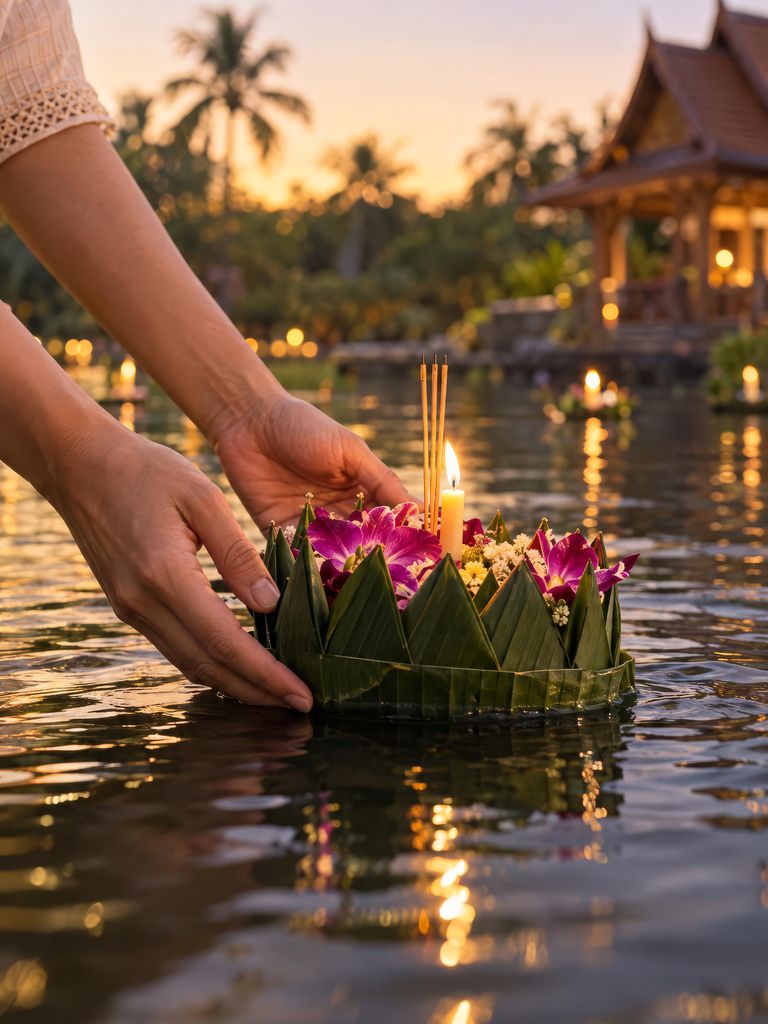
For a romantic bonus, consider Loy Krathong, the festival of floating candles, expected on Saturday 13 November 2027. Guests can float a krathong on the water the night before or after the wedding.
Seasons differ by coast. In Phuket and the Andaman Sea, Thai Meteorological Department normals show the dry season from December to March, with February the driest month. The wet season runs from May to October. On Koh Samui and the Gulf islands, the driest stretch is February to April, and October to December is wettest, peaking in November.
Bangkok works all year for an indoor ballroom wedding. Its wettest month is September, so an outdoor garden reception is safer from November onwards.
Thai public holidays matter too. The Bank of Thailand's 2027 holiday list includes Chakri Day on 6 April and Songkran from 13 to 15 April. It also lists Visakha Bucha on 20 May, the King's Birthday on 28 July and Queen Mother's Day on 12 August. On long weekends, Thai families travel, and beach resorts and roads are full.
Christmas and New Year are the most expensive and busiest weeks on both coasts. A wedding in late January or early February often gives you the same good weather with easier room blocks.
3 months to 1 month out
Three months to one month out is the logistics stage. Confirm the guest list, the rooming list and every arrival time, then build the transfer plan around them. Write the minute-by-minute timeline for the wedding day, agree the rain plan, and prepare the welcome packs. This is the list most couples underestimate.
Guests and rooms
- Close the RSVP list and send the final rooming list to the hotel or villa.
- Collect every guest's flight number, arrival time and passport name.
- Note who needs a step-free room, a cot or a quiet floor.
Transfers
- Group arrivals into transfer waves; send one car for VIPs and families.
- Plan boats for island venues, with a back-up for rough sea days.
- Book shuttles for the wedding night, with the last one well after the music ends.
The day itself
- Write the timeline from hair and make-up to the last song, with one owner for each step.
- Agree the rain plan and the time you will decide to use it.
- Time the ceremony for the light: sunset comes early in Thailand, all year.
- Confirm the seating plan, place cards, speeches and their order.
Welcome packs
- The week's programme, the dress code for each event and a map of the venue.
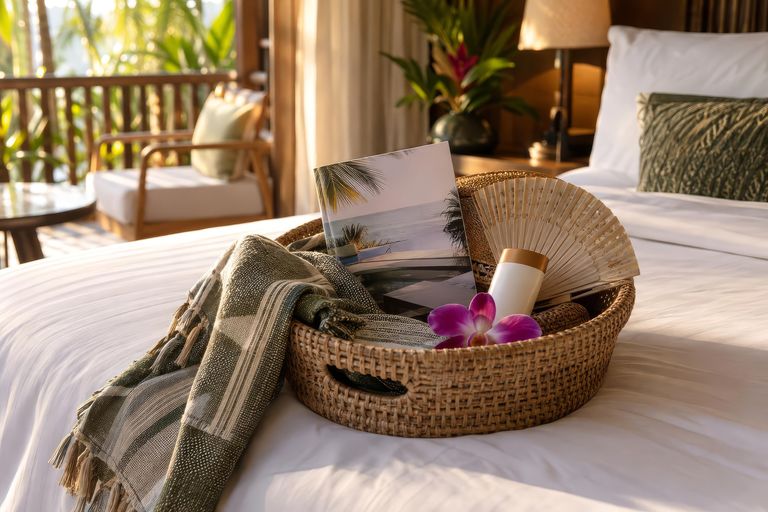
- A local SIM or eSIM, sunscreen that is safe for reefs, and a small fan.
- One planner and one phone number for every question during the wedding week.
For groups of 30 or more, a guest desk at the hotel for the whole week saves you from every small question. Our large group logistics team runs the desk, the transfer waves and the rooming list.
Suppliers and payments
- Send every supplier the final timeline and the name of the person in charge on the day.
- Pay final balances on the agreed dates and keep receipts in one place.
- Prepare envelopes for staff thank-yous, so nobody is forgotten on the night.
- Pack an emergency kit: sewing kit, plasters, spare shoes, phone chargers and umbrellas.
The last week before you fly
- Remind guests to complete the Thailand Digital Arrival Card within 3 days before arrival.
- Send the final programme and the transfer times to every guest.
- Pack the rings, outfits and legal folder in your hand luggage, never in the hold.
Arrive at least three days before the wedding. It gives you time to rest and meet the suppliers on site. Walk the venue at the hour of the ceremony, and you fix small problems before the guests arrive.
Wedding week: day by day
A wedding week in Thailand works best over four days. Plan arrivals and a welcome dinner, a free day on the water, the wedding, and a slow farewell brunch. Guests travel far, so give them time to rest between events. Example plan: four days, which you can stretch or shorten.
Day 1, arrivals. Guests land through the day and are met at the airport. In the evening, a relaxed welcome dinner by the sea, with Thai food and no speeches.
Day 2, the free day. A private yacht day to the islands, a spa morning, or a round of golf. In Phuket, see yacht charter in Phuket. Groups of more than 12 need a licensed passenger vessel under Thai law, so larger parties use a bigger boat or two.
Day 3, the wedding. A quiet morning, then hair and make-up. A late-afternoon ceremony timed for the light, cocktails at sunset, dinner, speeches and dancing. Plan the last shuttle after the music ends.
Day 4, the farewell. A late brunch by the pool, with no fixed start time. Guests leave in waves through the afternoon.
Many couples add a Thai element: a morning blessing by monks, a water-pouring ceremony with elders, or Thai dancers at the reception. Ask your planner how to include them with respect, and at the right time of day.
A shorter, three-day version. Drop the free day and hold the welcome dinner on arrival night. Marry the next day and finish with a farewell lunch. This suits a smaller group or guests with less time.
A Bangkok version. Replace the yacht day with a private river cruise on the Chao Phraya and a temple visit in the morning cool. Hold the reception in a ballroom and the after-party at a rooftop bar with a view of the city.
Whatever the length, protect the couple's time. Block a quiet hour before the ceremony and a private dinner for two on the night before. The best wedding weeks feel unhurried for the couple as well as the guests.

The day after and departures
The day after is about rest and smooth goodbyes. Plan departure transfers by flight time and keep the guest desk open until the last guest leaves. Send thank-you notes while the memories are fresh. For older guests, a private meet-and-assist service we book for you makes departure calm.
Airports of Thailand advises allowing at least 3 hours for international flights in the rainy season. Build that into every departure. If you are going on to a honeymoon, book the first night somewhere close, so you do not travel far the morning after.
Before you leave the venue, check the small things. Return rented items, collect gifts and cards, settle the final bill and confirm that the photographer has backed up every file. Ask a trusted friend or your planner to handle anything left over, so you can leave on time.
Send a short thank-you message to all guests within a week, with one photo from the day. The formal notes and the full gallery can follow later.
What is a realistic budget for a destination wedding?
A realistic budget starts from three numbers: how many guests, how many days you host, and which venue. The venue and the food and drink usually take the largest share. In Thailand, extras such as boats, transfers and a production team for a villa can change the total more than the flowers or the cake.
Decide who pays for what before you send invitations. Some couples cover rooms for all guests; others cover the events and leave rooms and flights to guests. Say it clearly on the wedding website. We give no package prices; Tanner prepares a written quote for your plan.
List every cost line before you compare quotes, so nothing is missed:
- Venue hire, food and drink for each event, with service charge and 7% VAT.
- Rooms you cover, and any minimum stay the hotel asks for.
- Flowers, styling, lighting, sound and any production for a villa.
- Photography, film, music, hair and make-up.
- Transfers, boats and the guest desk.
- Legal paperwork, translations and the registrar's visit if you marry in Thailand.
Ask whether each hotel quote is net or '++'. The Department of Internal Trade says a service charge should be 10% or less and must be shown before you order. VAT is 7% until 30 September 2027.
Use this checklist
Use this page as your working checklist for each stage, from 12 months out to the day after. It holds the venue questions, the guest travel page and the wedding-day timeline.
Share the link with your partner and your planner, and tick each line as you go. We re-check this page when the rules for entry, holidays or legal registration change.
Plan your wedding week with Tanner
Tanner, your planner, runs the whole wedding week, from the venue search to the last departure. We hold the room block, run the guest desk, book the boats, cars and suppliers, and keep the timeline on the day. When it is over, we can plan your honeymoon too.
On the day itself, no supplier calls you. Every question about boats, cars, timings and rain comes to us, and you get married.
Tell us the month, the coast you like and roughly how many guests. We get back to you right away with venues that fit, a draft programme for the week and the next steps in writing.
The essentials
0 of 6 ready