Can you move to Thailand?
You have a school in mind, a home in view and a start date. What you do not have yet is the visa, and that comes first.
Yes, on a long-stay visa. Thailand welcomes long-term residents through the Long-Term Resident visa, Thailand Privilege, the Destination Thailand Visa, and retirement visas from age 50. Visa-free entry is something else: since 15 September 2026 it gives up to 30 days, for tourism only.
That rule matters. Nationals of 60 countries and territories can enter without a visa for up to 30 days. They can extend once by up to 30 more days at an immigration office for ฿1,900. Land entries on the exemption are limited to twice a year for most nationalities. None of this is a basis for living here. You need a long-stay visa.
The long-stay routes are clear, and for wealthy families, retirees and senior professionals they are generous. This guide takes the move in the order that works: the visa, the city, the home, the money, health, family and your first 90 days.
Who moves here? Families who want space, good schools and a full household team. Entrepreneurs and senior professionals who work across Asia. Retirees who want warm weather, excellent hospitals and a slower pace. Each follows the same steps, in a slightly different order.
Step 1: choose the right visa
The right visa depends on your age, your income and whether you will work. The LTR suits high earners, investors and retirees with strong passive income. Thailand Privilege suits anyone who wants a long stay without proving income. The DTV suits remote workers. The O-A and O-X suit retirees from 50.
- Long-Term Resident (LTR) visa. Ten years, multiple entry, run by the Board of Investment (BOI). Four categories: wealthy global citizens, wealthy pensioners, work-from-Thailand professionals and highly-skilled professionals. The fee is ฿50,000 per person when collected in Thailand. Holders who work pay ฿3,000 a year for a digital work permit.
- Thailand Privilege. A paid membership, not a money test. Gold costs ฿900,000 for 5 years and Platinum ฿1,500,000 for 10 years. Diamond costs ฿2,500,000 for 15 years, and Reserve ฿5,000,000 for 20 years or more, by invitation. Bronze (฿650,000, 5 years) is still listed by Thailand Privilege and expected to close to new applicants at the end of 2026. It gives no right to work.
- Destination Thailand Visa (DTV). Five years, multiple entry, for remote workers, freelancers and people doing Thai "soft-power" activities such as Muay Thai or cooking courses. Stays of up to 180 days per entry, with one extension of up to 180 days. You need ฿500,000 in the bank over the last 3 months, or a sponsor letter. The fee is ฿10,000, according to the Ministry of Foreign Affairs.
- Non-Immigrant O-A (retirement). From age 50, for one year, with no work. You need ฿800,000 in the bank, or ฿65,000 a month in income, or a mix totalling ฿800,000 a year. Health insurance of at least ฿3,000,000 or USD 100,000 is required, the Royal Thai Embassy in Oslo says.
- Non-Immigrant O-X. From age 50, for nationals of 14 countries, including the UK, the US, Australia, Canada, Germany and Japan. You need a ฿3,000,000 deposit in a Thai bank, or ฿1,800,000 plus ฿1,200,000 yearly income, and Thai health insurance.
Which is best? Our advice: the LTR if you qualify. It lasts ten years, allows work and replaces the 90-day report with a yearly one. If speed matters more than cost, Thailand Privilege is the simplest. Our LTR visa guide and visa comparison set out each route in full.
Start the visa three to six months before the move, not in the last month. The BOI says it gives its LTR endorsement result within 20 working days. But every route needs documents from your home country, often with certified translations, and those take longest.
Can you live in Thailand as a UK, US or Gulf citizen?
Yes. UK, US and Gulf citizens use the same visa routes as everyone else. All can enter visa-free for up to 30 days as tourists. Nationality limits apply only to the O-X retirement visa, which the Thai government offers to 14 countries, including the UK and the US.
Gulf citizens, including those of the UAE and Saudi Arabia, mostly choose the LTR or Thailand Privilege; the O-X list does not include them. For British citizens, the UK government's "Living in Thailand" guide on GOV.UK is a useful companion on healthcare, pensions and documents.
Step 2: where to live
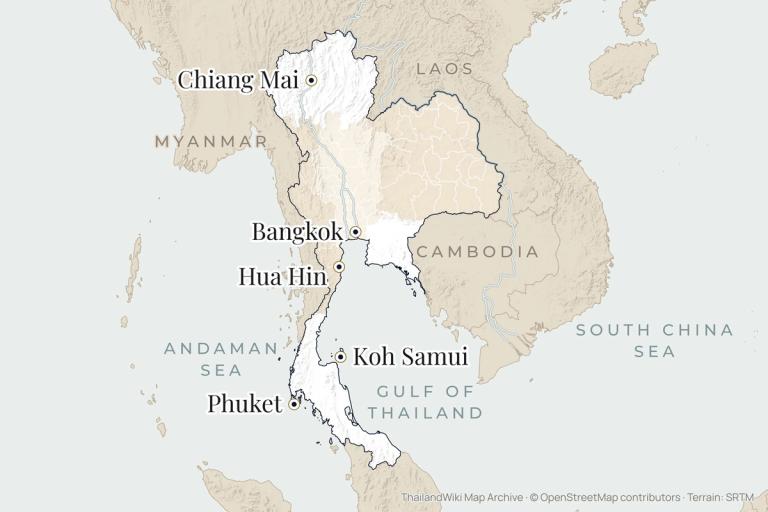
Most new residents choose Bangkok for business, schools and healthcare, or Phuket or Koh Samui for island life. Others pick Chiang Mai for a calmer city in the hills, or Hua Hin for a quiet seaside town within reach of the capital. Visit before you commit: a week's viewing trip saves months of regret.
- Bangkok. Sukhumvit for international schools and restaurants, the riverside for views and calm, Lang Suan and the embassy district for central, leafy streets. Each has a different pace, and many families rent in two areas before choosing.
- Phuket. The west coast for villas and beach life, with JCI-accredited hospitals in Phuket Town and an international airport.
- Koh Samui. Villa living on a smaller island, with its own airport; Bangkok Hospital Samui is the main international hospital, though it is not JCI-accredited.
- Chiang Mai. A university city with a strong expatriate community, cooler nights from November to January, and a smoky season from February to April.
- Hua Hin. A royal seaside town about 2 hours 50 minutes by car from Suvarnabhumi Airport (checked November 2026), popular with retirees and golfers.
Think about the year, not the holiday. Visit your city in its hottest or wettest month as well as the cool season. Test the school run, the drive to the hospital and the flight connections you will use most.
Bangkok suits families who need the best schools and hospitals within a short drive. The islands suit those who can work remotely and want space. Chiang Mai and Hua Hin suit retirees who want a calmer pace. Our Live in Thailand chapter has a guide to each.
Step 3: rent or buy a home
Most new residents rent first and buy later. Foreigners may own a condominium unit freehold, in their own name, under the Condominium Act. Foreign ownership in the building must stay within 49% of the total unit floor area, and the money must come from abroad in foreign currency.
Foreigners cannot own land in their own name. You can own a building on leased land, and a registered land lease runs up to 30 years per term. Renewal options are contract terms, not guaranteed by law. Take independent legal advice before you sign.
Renting gives you time to learn the city. Furnished condominiums and serviced apartments are easy to find in Bangkok, and villas with staff on the islands. For buyers, branded residences managed by international hotel groups are a popular choice; our buying property guide explains the rules and the process.
A good first lease is one year, furnished, with clear clauses on deposit return and repairs. Get the landlord's written confirmation that the unit is registered and that family members may stay. Have your independent lawyer review the lease before you sign.
Whatever you choose, use a licensed lawyer for the contract and the title check. Keep the bank records that show the purchase money came from abroad in foreign currency.
Step 4: bank account, money and tax
Open a Thai bank account once the long-stay visa is in your passport, and take tax advice before you bring money in. Banks set their own documents for foreign customers. Under the Revenue Code, you become tax resident after 180 days or more in Thailand in a calendar year.
Each bank and branch has its own checklist for foreign residents, so ask first. We book the appointment and send a member of our team with you.
Plan tax early. Under the Revenue Department's instruction Por. 161/2566, foreign income that arose from 1 January 2024 in a resident year is taxed when it is brought into Thailand. Income that arose before 2024 is not. The LTR includes tax benefits for some categories. VAT is 7% until 30 September 2027, under Royal Decree No. 807.
You may bring any amount of foreign currency in, but declare foreign cash above USD 15,000 to Customs. Baht over ฿450,000 must also be declared. Keep records of every transfer from abroad. They help with property and with tax.
Step 5: health insurance and hospitals
Health insurance is required for the O-A, O-X and LTR visas, and wise for everyone. Thailand has excellent private hospitals. Bangkok's JCI-accredited international hospitals include Bumrungrad International, Samitivej Sukhumvit, BNH and Vejthani. Phuket has Bangkok Hospital Phuket and Bangkok Hospital Siriroj; Chiang Mai has Bangkok Hospital Chiang Mai and Chiangmai Ram.
The visa rules set different minimums. The LTR asks for at least USD 50,000 of cover, or an approved alternative. The O-A asks for at least ฿3,000,000 or USD 100,000, the Royal Thai Embassy in Oslo says. The O-X asks for Thai health insurance. Tourists on the visa exemption need none by law, though it is still wise.
Choose an international policy that covers you in Thailand and at home, with direct billing at the hospitals you will most likely use. Keep a copy of the policy certificate with your visa papers. Immigration may ask for it at each renewal.

Step 6: schools, pets, driving and staff
Families should choose schools early: the best international schools have waiting lists. Then plan pets, driving and household staff. Bangkok has the widest choice of international schools; Phuket and Chiang Mai have strong options too. We shortlist schools and book the visits.
- Schools. Visit two or three schools in person, and ask about waiting lists, curriculum and the school run from your chosen area.
- Pets. Bringing a dog or cat takes paperwork and time, so plan several months ahead.
- Driving. Thailand accepts an International Driving Permit issued under the 1949 Geneva Convention, or a licence from another ASEAN country. Otherwise you can get a 30-day temporary licence at the Provincial Land Transport Office.
- Household staff. Many families employ a housekeeper, a nanny and a driver. Staff need the right work papers, and contracts should be in writing. For permanent staff, a recruitment partner of ours places people on monthly terms.
Phones are simple: AIS, True and dtac sell tourist SIMs at the main airports, and residents move to a monthly plan once settled. Bangkok's Metropolitan Waterworks Authority says its tap water is safe to drink, though most homes use filtered water.
Your first 90 days
In your first 90 days, finish the arrival steps, register your address and set up the paperwork you will use every year. Before you fly, fill in the free Thailand Digital Arrival Card online within 3 days of arrival. After 90 days in the country, report your address to immigration.
- Arrival card. The TDAC is free and is not a visa. The only official site is tdac.immigration.go.th; ignore look-alike paid sites.
- 90-day report. Anyone staying over 90 days reports their address every 90 days, online from 15 days before to 7 days after the due date. A late report costs a ฿2,000 fine, according to the Immigration Bureau. LTR holders report once a year instead.
- Re-entry permit. The Immigration Bureau charges ฿1,000 for a single re-entry permit or ฿3,800 for a multiple one; the LTR includes a multiple re-entry permit. Leaving Thailand also restarts the 90-day count, according to the Immigration Bureau.
- Identity. Carry your passport or a copy of the photo page and your latest stay stamp. The fine for not carrying it is up to ฿2,000.
- Extensions. Each extension of stay costs ฿1,900, including the yearly retirement extension. That extension needs ฿65,000 a month in income or ฿800,000 in a Thai bank, under Immigration Bureau rules.
Keep one folder of every document: passport copies, visa pages, the arrival card, your lease and your bank letter. Most appointments in your first year ask for the same papers.
Your landlord, your bank and your employer will each ask for copies of your passport and visa. Our team keeps a digital set ready to send when an office asks.
Does it cost less to live in Thailand?
For most families, a luxury life costs less in Thailand than in Singapore, Hong Kong or Dubai, mainly because of housing and staff. Schools, imported goods and international healthcare cost much the same as in other Asian capitals. The real saving is in space and service: a larger home and a full household team.
We do not print living-cost figures, because they depend on your city, home and lifestyle. Our cost-of-living guides for Bangkok and Chiang Mai compare the main items, and we prepare a personal budget once we know your plans.
The biggest variables are the rent or purchase price, school fees, cars and drivers, and how often you fly home. A family in central Bangkok with two children in international school has a very different budget from a retired couple in Hua Hin. We price both kinds of move.
Plan your move with Tanner
Tanner, your planner, handles the move around the visa for you. We plan your trip, shortlist schools, arrange drivers and household staff, and connect you with licensed visa and tax advisers. On request, we connect you with a property agent we trust and an independent lawyer. One planner stays your contact from the first call to the day your family settles in.
Our relocation services page shows how the support works. Tell us who is moving, from where and when, and we send a clear plan. We get back to you right away.