Why calm matters: jai yen and saving face
You have a dinner with Thai partners tonight and a temple visit in the morning. These are the manners that matter in both rooms. The point most visitors miss: a Thai smile does not always mean yes, so confirm key points in writing.
In Thailand, good manners start with keeping calm. Raising your voice or showing anger in public loses respect, even when you are right. Thais value jai yen, a "cool heart", and they avoid making anyone lose face. Disagreement is expressed quietly, often in private.
Face means a person's dignity in front of others. Criticising someone in public causes a loss of face. So does correcting a senior person in a meeting, or arguing with staff in front of guests. The person may smile and agree, but the relationship suffers.
A smile does a great deal of work in Thai life. People smile to say thank you, to say sorry, to calm a tense moment, or to avoid an awkward no. Read it with care: a smile does not always mean yes.
When something goes wrong at a hotel or a restaurant, speak quietly to the most senior person present, away from other diners. Explain the problem and what you would like done. A calm word in private gets a faster and better result than a raised voice.
The phrase mai pen rai, roughly "never mind" or "it is nothing", is part of the same calm. You will hear it often. It is a way to let small problems pass without blame.
Another word you may hear is kreng jai. It describes the wish not to trouble or embarrass others. A Thai colleague may not ask you a question, or may accept a plan they doubt, out of kreng jai. Make it easy for people to speak: ask open questions, give time to answer, and thank people for honest views. Once you understand kreng jai, you get better advice, because people feel safe telling you the truth.
How to greet people: the wai and "sawasdee"
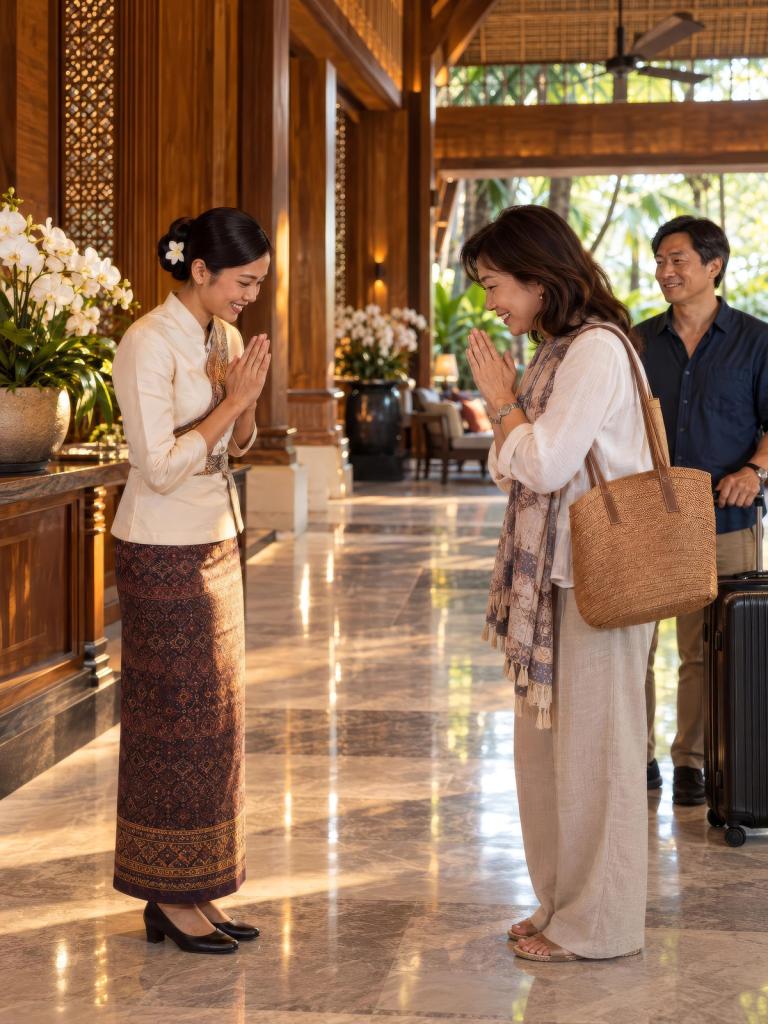
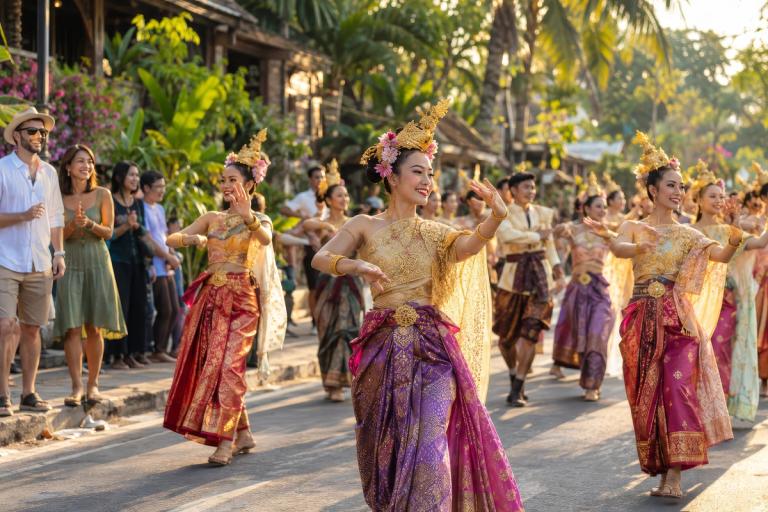
The wai is the Thai greeting: you press your palms together at chest height and bow your head slightly. It is given first to older or senior people, and it also says thank you or sorry. Say sawasdee khrap if you are a man, or sawasdee kha if you are a woman.
How to wai. Hold your palms together, fingers pointing up, close to your chest. Bow your head a little. The higher the hands and the deeper the bow, the more respect it shows. For an older person or a senior host, raise your fingertips towards your nose.
Who gives it first. The younger or more junior person usually gives the wai first, and the other person returns it. As a guest, you can return a wai with a smaller one of your own.
Staff and children. You do not need to wai hotel staff, waiters or children first. A smile and a small nod are the polite reply when staff greet you with a wai.
Monks. Monks do not return a wai, and they receive the deepest one. Raise your hands higher and bow lower when you greet a monk.
Busy hands. If your hands are full, a smile and a small nod are enough. Nobody expects you to put down your shopping to wai.
Handshakes. In business, many Thai professionals shake hands with foreign guests. Follow your host's lead. If a Thai colleague offers a wai, return it.
A few words of Thai make a real difference. Khop khun khrap or kha means thank you. Our guide to Thai phrases has the rest.

What is considered disrespectful in Thai culture?
In Thai culture, it is disrespectful to touch someone's head, point your feet at people or Buddha images, or lose your temper in public. Speaking badly of the royal family is far worse. Pointing at people with one finger, or stepping over someone sitting on the floor, is also rude.
- The head: it is the highest part of the body. Do not touch anyone's head, even a child's, and do not pass things over someone's head.
- The feet: they are the lowest part of the body. Do not point them at people or Buddha images, rest them on tables, or move objects with them.
- Pointing: use an open hand, palm up, to show direction. Do not beckon with a raised finger.
- Anger: shouting or arguing in public causes loss of face for everyone.
- Banknotes: they carry the King's image. Treat them with care, and never step on a note or coin to stop it rolling away. This is a matter of respect rather than law. The Bank of Thailand says even writing on a note carries no penalty, but asks people not to.
- Monks: women should not touch monks, a rule Wat Pho states on its own site.
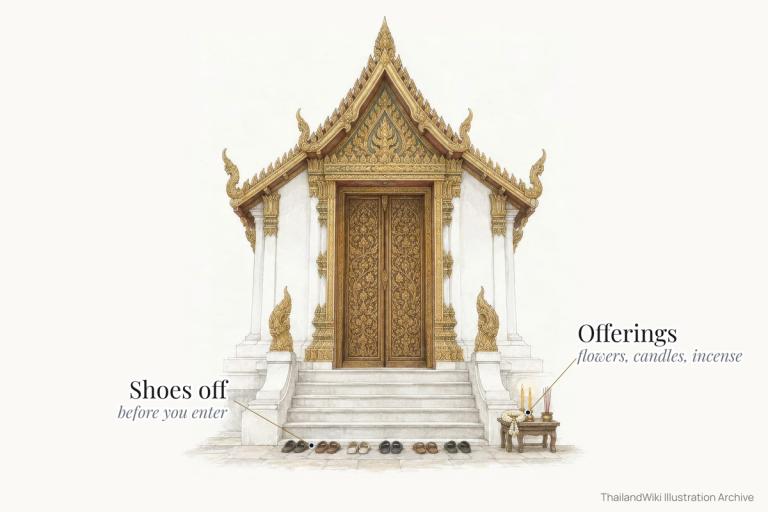
- Shoes indoors: take them off when you enter a Thai home and many temple buildings.
- Passing things: use your right hand, or both hands, to give and receive. For a senior person, support your right arm with your left hand.
- Stepping over people: walk around someone sitting on the floor, never over them or their food.
Thais are generally forgiving of an honest mistake. A smile, a small wai and a quiet sorry repair most small errors.

The monarchy and national symbols
Insulting the King, Queen, Heir or Regent is a serious crime in Thailand under Criminal Code section 112, and this includes online posts. Treat images of the royal family, on banknotes, in public buildings and in homes, with the same respect Thais show.
The national anthem. It plays at 08:00 and 18:00 in public places, such as parks and stations. Stop and stand still until the anthem ends.
The royal anthem. It plays before films in cinemas. Stand when it plays.
The flag. Treat the Thai flag with respect. Do not sit on it, wear it as clothing in a careless way or use it as a decoration.
If you are unsure, the safest course is simple. Do not discuss the monarchy at all, especially with people you do not know well.
Temples: dress code and behaviour
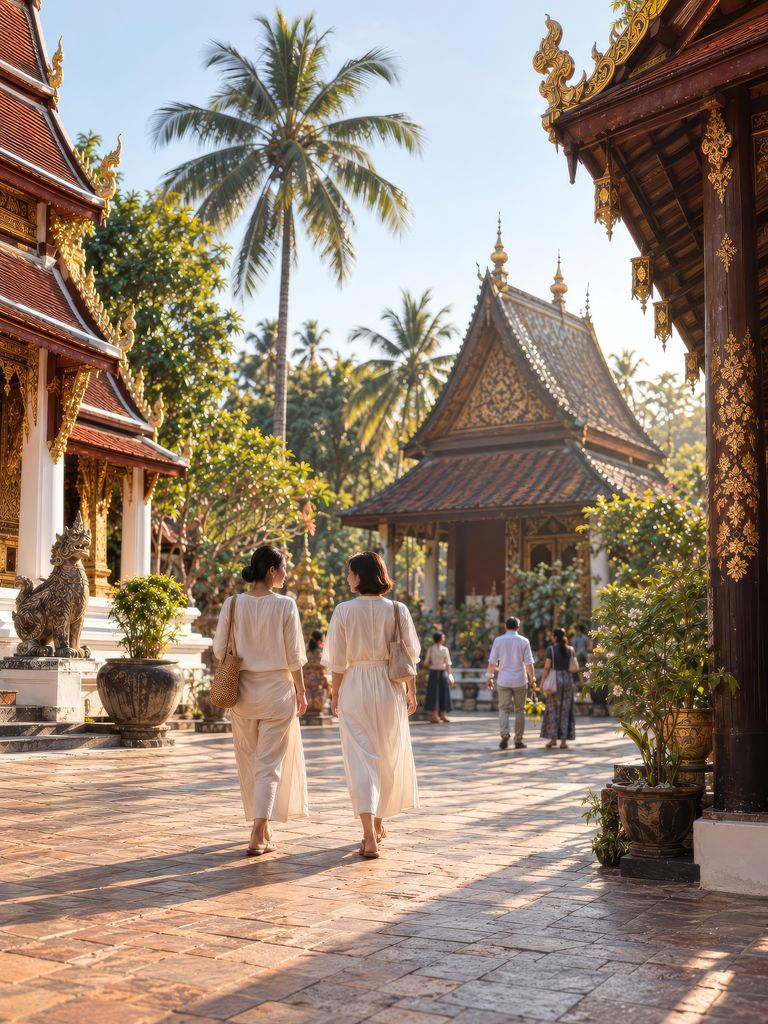
At temples, cover your shoulders and knees, and remove your shoes before you enter any building. Wear sleeves, and trousers or a skirt below the knee. Inside, sit with your feet pointing away from the Buddha image, speak quietly, and never climb onto a statue.
Dress. Avoid sleeveless, crop, tight or revealing tops. The Grand Palace has its own stricter list of banned clothes, published by the Bureau of the Royal Household.
Inside the hall. Sit lower than the Buddha image, with your legs folded to the side. Do not turn your back on the image to take a selfie close to it. Follow the photo signs: photos are not allowed inside the main chapel of the Emerald Buddha at the Grand Palace.
Monks. Monks are respected teachers. Women should not touch them or hand things to them directly. Place a gift down near the monk, or ask a man to pass it. On public transport, give monks space and offer your seat.
Offerings. Small offerings, such as flowers, candles or incense, are welcome at many temples. Watch how Thai visitors do it and follow quietly.
Holy days. Temples are busiest on Buddhist holy days, when many Thai families visit to make merit. In 2027, Makha Bucha falls on Sunday 21 February and Visakha Bucha on Thursday 20 May. Visit early, dress with extra care, and expect alcohol sales to stop outside hotels and licensed venues.
Songkran. UNESCO inscribed Songkran, the Thai New Year, on its list of the Intangible Cultural Heritage of Humanity in 2023. The public holidays in 2027 are 13 to 15 April. Water play is part of the fun, but never splash monks, older people or anyone who is clearly not taking part.
Our temple dress code guide lists what to wear at each of the main Bangkok temples.
Thai business etiquette
Thai business etiquette values respect, patience and relationships. Address people as Khun before their first name, exchange business cards with both hands, and expect some friendly small talk before business. Seniority matters, and decisions often take longer than visitors expect.
Names and titles. Thais use first names with the polite title Khun: Khun Somchai, Khun Malee. Use the title in meetings and emails.
Business cards. Give and receive cards with both hands, or with the right hand supported by the left. Read the card for a moment before you put it away. Do not write on it in front of the person.
Seniority. Greet the most senior person first and let them lead. Seating, speaking order and who pays all follow seniority.
Meetings. Expect small talk first: family, food, travel and your impressions of Thailand. Keep disagreement private and gentle. A direct no is rare, so listen for soft signals such as "we will consider it".
Gifts. Small, good-quality gifts from your home country are welcome at a first meeting. Present them with both hands. The receiver may not open the gift in front of you.
Time. Arrive on time, and set off early, because Bangkok traffic can be slow. If you will be late, call ahead. Your host will do the same.
Language. Many Thai executives speak excellent English, but it may be their second or third language. Speak clearly, avoid slang, and confirm key points in writing after the meeting.
Follow-up. After the meeting, send a short thank-you and a summary of what was agreed. Keep the tone warm and the points clear, and give your partners time to reply.
Dress. Bangkok business dress is smart and conservative: a suit or a jacket and trousers for men, and a smart dress or suit for women. Light fabrics help in the heat.
Thai professionals are educated, well travelled and quick to spot respect. Good manners build the trust that makes deals happen. For hosting Thai partners, see our guide to client entertainment.

Dining etiquette: sharing, spoon and fork, who pays
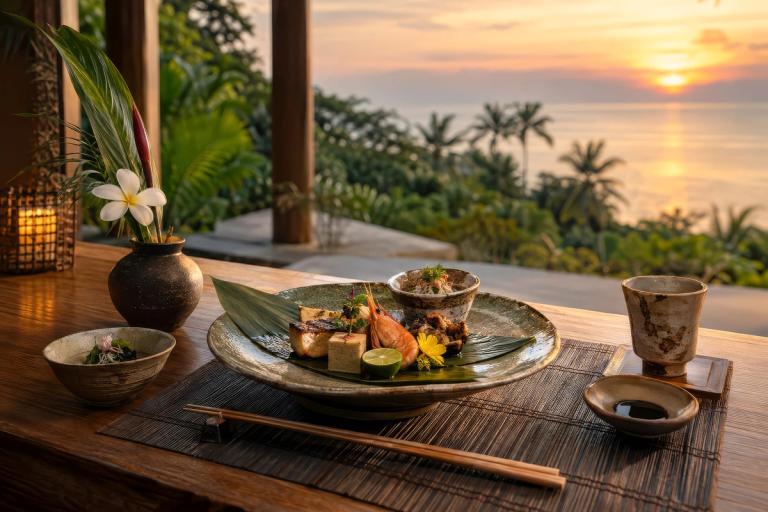
Thai meals are shared. Dishes arrive in the centre of the table, and everyone takes a little from each. Eat with the spoon in your right hand and use the fork to push food onto it. The host or the most senior person usually pays.
Sharing. Take a small spoonful from a shared dish at a time, and add it to your rice. Do not pile your plate high, and leave a little for others.
Spoon and fork. The spoon goes to your mouth, the fork does not. Chopsticks are used for noodle dishes.
Sticky rice. In the north and north-east, sticky rice is eaten with the fingers of the right hand.
Starting the meal. Wait for the host to invite you to eat. The host may serve you the first spoonful of a special dish, which is an honour.
Seasoning. A small set of condiments usually sits on the table: fish sauce with chilli, dried chilli, sugar and vinegar. Taste first, then season to your liking.
Have you eaten? Thais often greet friends with a question that means "have you eaten yet?". It is a warm hello, not an invitation, so a simple yes or a smile is enough.
Who pays. The host or the most senior person usually pays, and splitting the bill is less common at a formal dinner. If you invited the group, you pay. If a Thai host insists, accept graciously and return the favour later.
Service charge. The Department of Internal Trade says service charge should be 10% or less and must be shown before you order. "++" on a menu means service charge and 7% VAT are added on top. Our tipping guide explains what to leave.
For an important business dinner, book a private room. Bangkok has two three-star restaurants in the MICHELIN Guide Thailand 2026, Sorn and Restaurant Sühring, and many more with one or two stars. The 2027 selection is revealed on 10 November 2026.
Can you kiss or hold hands in public in Thailand?
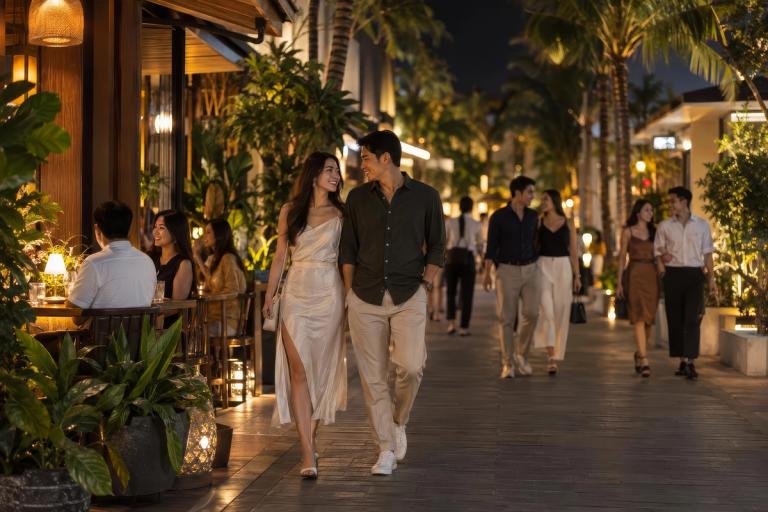
Holding hands in public is fine in Thailand. Many Thai people find kissing in public impolite, especially outside Bangkok and near temples. Thai couples keep affection for private moments. Follow the same quiet custom, and you feel welcome wherever you go.
In big hotels, rooftop bars and beach resorts, a short kiss between partners will not cause a problem. At temples, markets, government offices and in small towns, keep it to holding hands. This applies to every couple. On the beach, swimwear is normal, but cover up before you walk into town or a restaurant.

Nightlife and hospitality etiquette
In Thai nightlife, dress well, carry ID and treat staff and hosts with respect. Good venues have dress codes, check that you are over 20, and expect calm behaviour. Thai hosts and staff are professionals, and polite manners get you the best service.
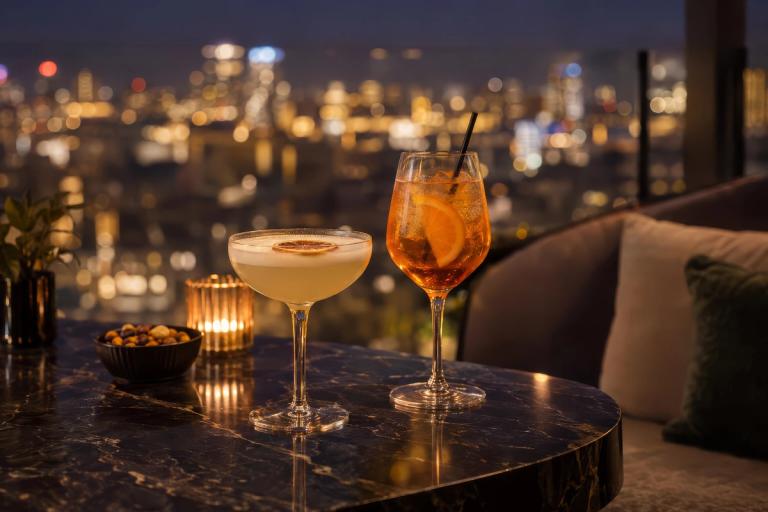
Dress codes. Rooftop bars and smart clubs expect smart casual. Avoid sportswear, flip-flops and shorts in the evening.
ID. The legal age for buying alcohol is 20, and licensed entertainment venues may not admit anyone younger. Carry your passport or a copy.
At the table. Do not put your feet on seats or tables. If someone pours for you, pour for them too. Toast with a smile and a raised glass.
Private karaoke. KTV lounges with private rooms are a popular part of Thai business entertaining. If you are invited, join in. Nobody expects a good voice; taking part is the courtesy.
Respect. Treat bar staff, hosts and servers as the skilled professionals they are. Mixed Thai and foreign teams going out together after work is normal business life in Bangkok.
Licensed entertainment venues in Bangkok, Chonburi (including Pattaya), Phuket, Chiang Mai and Koh Samui may open until 04:00. So may licensed venues inside hotels anywhere in Thailand. Ordinary bars and restaurants close earlier, usually by 2am. Plan a driver for the ride home.
Laws visitors confuse with manners
Some Thai rules look like manners but are law. You must carry your passport or a copy, alcohol sales stop on five Buddhist holy days, vapes are illegal, and drones need registration. Breaking these brings fines or worse, not just a frown.
ID. Foreigners must carry a passport or a copy of the photo page and entry stamp. The fine is up to ฿2,000.
Alcohol days. Alcohol sales are banned on Makha Bucha, Visakha Bucha, Asanha Bucha, Khao Phansa and Ok Phansa. Hotels and licensed entertainment venues are exempt.
Vapes. E-cigarettes and vapes are illegal. Importing them can bring up to 10 years in prison under the Customs Act.
Drones. Register with both the NBTC and the Civil Aviation Authority of Thailand before you fly.
Cannabis. Since June 2025, licensed shops may sell cannabis buds only with a prescription. Taking cannabis out of the country is not permitted.
Drink-driving. The limit is 50 mg of alcohol per 100 ml of blood, and 20 mg for new or unlicensed drivers. A driver is the polite and the legal answer after a business dinner.
Our guide to Thai laws for visitors covers each rule with its source.
Gifts, tipping and saying thank you
In Thailand, give small gifts wrapped neatly, present them with both hands, and avoid black wrapping, which is linked with mourning. Tip in cash for good service. Say khop khun khrap or kha, with a smile, to thank anyone who helps you.
Gifts for hosts. Flowers, good chocolates, fruit baskets or a quality item from your home country all work. Avoid anything too personal or too expensive at a first meeting.
Tipping. Hand tips discreetly, in cash. Leave them with the bill folder, or give them directly with a smile.
Thank-you notes. After a dinner or a meeting, a short message the next day is appreciated. Thais remember courtesy.
Seasonal gifts. At New Year, gift baskets of fruit, food or drink are a common way to thank business partners. If a Thai partner sends you one, a thank-you call or message is the right reply.
Receiving a gift. Accept with both hands and a thank you. Open it later, unless the giver asks you to open it now.
Plan it with Tanner
Tanner prepares you before meetings and dinners with Thai partners, so you arrive knowing the rules. We brief you on names, titles and seating, and choose the right restaurant and private room. We also arrange gifts that fit the occasion. Tell us who you are meeting, and we plan the rest.
You walk into the meeting knowing who to greet first, where to sit and which gift to bring. The rest of the evening is ours to arrange.