Is Thailand a good destination for medical tourism?
Yes, for many planned treatments. Thailand has private hospitals on the Joint Commission International list, international patient departments, interpreters and English-speaking specialists. The right way to choose is by accreditation and by the specialist who will treat you. Price comes last: for a complex case, the lowest quote is rarely the safest choice.
You have a knee operation booked in Bangkok, and your family wants to come too. Here is how to choose the hospital and plan the weeks around it.
Joint Commission International (JCI) is a United States-based body that inspects hospitals outside the United States against its own patient-safety standards. A hospital on its list has passed that inspection for its whole hospital programme. JCI accreditation does not rate single doctors, and it does not promise any result.
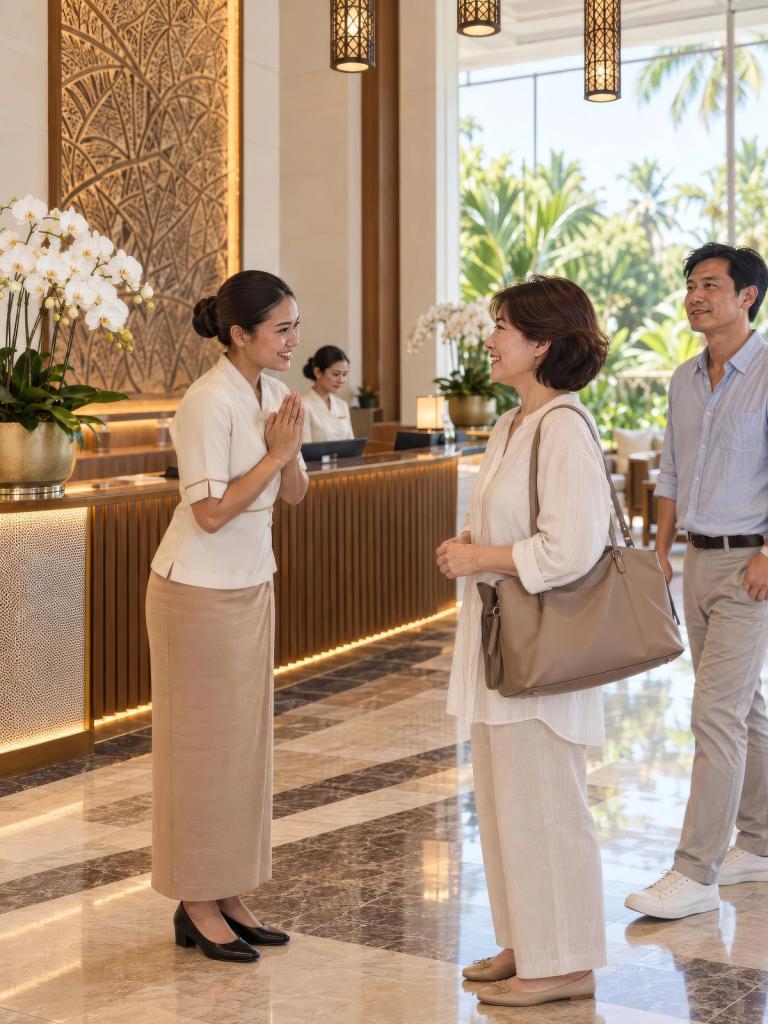
The large private groups in Bangkok are built for foreign patients. Most have an international desk that books appointments, checks your insurance and arranges interpreters. Ask the hospital which languages it covers for your department before you book, because cover differs between specialties.
One check most patients skip: search the hospital on the JCI website yourself before you book. Accreditation can change after each new inspection, and the list is public.
Thailand suits planned care best: a full health check, a joint replacement, dental work or cosmetic surgery booked weeks ahead. It suits emergencies less well if you are far from a big city. On the islands, the nearest JCI hospital may be a flight or a boat ride away.
Our role is the logistics around your care. We do not give medical advice, recommend surgeons or quote treatment prices. We arrange the flights, the recovery stay and the transfers to every appointment. We also find the people who make a hospital stay easier for you and your family.
JCI-accredited hospitals by city
These are the Thai hospitals on the Joint Commission International list that foreign visitors use most, checked against the list on 30 October 2026. Bangkok has the widest choice and the most specialists. Phuket, Chiang Mai and Pattaya each have at least one JCI hospital. Koh Samui does not.
Bangkok. These four appear on the JCI list under their own names:
- Bumrungrad International, Sukhumvit Soi 3, listed as Bumrungrad Hospital Public Company Limited
- Samitivej Sukhumvit Hospital
- BNH Hospital, Convent Road, Silom
- Vejthani Hospital, Lat Phrao
Bangkok Hospital on Soi Soonvijai, New Phetchaburi Road, is the flagship of its group. JCI lists a 'Bangkok Hospital Headquarters'. We have not confirmed that this listing is the same campus, so we name the hospital here without the JCI label until we do.
Phuket. Bangkok Hospital Phuket and Bangkok Hospital Siriroj are both on the JCI list. Both are in Phuket Town, on the east side of the island. From the west-coast beaches, plan the drive into town for every appointment.
Chiang Mai. Bangkok Hospital Chiang Mai and Chiangmai Ram Hospital are both on the JCI list. They serve the north, including guests who stay in the mountain resorts outside the city.
Pattaya. Bangkok Hospital Pattaya, on Sukhumvit Road on the Naklua side, is on the JCI list. It is the main private hospital for the eastern seaboard.
Koh Samui and Koh Phangan. Bangkok Hospital Samui in Chaweng is the island's international hospital, but it is not on the JCI list. Phangan International Hospital, a branch of Bangkok Hospital Samui, runs on Koh Phangan. Our advice for planned treatment on the islands: fly to Bangkok.
Accreditation can change when a hospital is inspected again. Before you book, search the hospital's name on the Joint Commission International website, or ask the hospital for its current certificate. For the wider picture of care for residents, see our guide to healthcare in Thailand.
Which hospital in Thailand is best for medical tourism?
There is no single best hospital. The best choice is the JCI hospital where the right specialist for your condition works. A hospital known for heart care may not lead in fertility or spine surgery. Start from the doctor and the department, then check the hospital's accreditation and international services.
Ask each hospital's international desk for the name of the specialist, their training and how many of your procedures they do. Ask who will look after you after the operation and who you call at night. A good desk answers in writing and in your language.
You can check any doctor's licence yourself. The Medical Council of Thailand runs an online licence search with an English version, and a separate search for temporary licences given to foreign doctors. If a doctor's name does not appear, ask the hospital why before you go further.
For cosmetic surgery the same rules apply. We do not rank surgeons, and we suggest you treat any 'best surgeon' list with care. Choose an accredited hospital and check the licence. See the surgeon in a video consultation first, and ask for a written plan that covers aftercare and follow-ups.

Common treatments people travel for
Most foreign patients come for planned care that they can book weeks ahead. The usual reasons are full health check-ups, orthopaedics, heart care, dental work and cosmetic surgery. Each hospital has its strongest departments, so ask about yours. We give no outcome or price claims here, because only your doctor can.
- Health check-ups: packages of scans and blood tests, usually done in one visit, with a doctor to explain the results.
- Orthopaedics: knee, hip and spine surgery, with physiotherapy in the hospital before you go home.
- Heart care: tests and planned procedures with a cardiologist you meet before you fly.
- Dental care: implants, crowns and full treatment plans, usually split over two or more visits.
- Cosmetic surgery: face and body procedures, which need a longer stay before you are cleared to fly.
- Fertility care: treatment cycles that need a longer stay, planned around the clinic's calendar.
You can pair a health check with a longer wellness stay. Our guide to longevity and medical wellness covers the clinics and resorts that build programmes around test results.
Visas for medical treatment
Short treatment often fits inside the 30-day visa exemption, which covers nationals of 60 countries and territories since 15 September 2026. Longer care needs a visa. The Thai e-Visa website lists a medical treatment visa, and the Destination Thailand Visa (DTV) also covers medical treatment as a soft-power activity.
The 30-day exemption is for tourism. You can apply once at an immigration office for up to 30 more days, at the officer's discretion, for a fee of ฿1,900. For a short procedure with a quick recovery, this is often enough.
The Thai e-Visa website, run by the Ministry of Foreign Affairs, lists two medical treatment visas. For treatment under 60 days it asks for a letter of appointment from the hospital and funds of at least ฿20,000. For treatment over 60 days it asks for funds that cover medical fees and living costs. Both are single entry and valid for 3 months. The Department of Consular Affairs also describes medical stays on a Non-Immigrant O visa. It gives 90 days per entry, at ฿2,000 single entry or ฿5,000 multiple entry. You need an acceptance letter from a Thai government-accredited hospital.
The DTV is a 5-year multiple-entry visa. It allows up to 180 days per entry, with one extension of up to 180 days. You need ฿500,000 in the bank over the last 3 months, or a sponsor letter, and the fee is ฿10,000. Our DTV visa guide explains each step.
You must apply for an e-Visa from outside Thailand. Rules for a family member travelling with you depend on the embassy, so ask the embassy that handles your application before you book flights.
Planning care: before you fly
Good planning starts at home. Send your medical records and scans to the hospital, get the treatment plan in writing, and agree the dates for surgery and follow-ups. Ask your insurer for written approval before you travel. Most travel insurance excludes planned treatment abroad, so check the wording first.
Tourists do not need health insurance to enter Thailand. Long-stay visas such as O-A, O-X and the Long-Term Resident visa do need it. Our guide to health insurance in Thailand explains the difference between travel cover and an international health plan.
For a large treatment plan, ask for a second opinion before you agree. Many hospitals review your records by video before you commit. Keep copies of every report in one folder, in English, so a doctor at home can follow up.
Ask your surgeon how long you must stay before you are cleared to fly, and get the clearance in writing. Book a flexible return ticket. Allow at least 3 hours at the airport for international flights in the rainy season, as Airports of Thailand advises. Ask for wheelchair help if you need it.
Recovery in comfort
Recovery is where private planning makes the biggest difference. A week in a hotel room far from the hospital is tiring. We arrange a quiet suite or a private villa close to your hospital. A chauffeur drives you to every follow-up, and we arrange help for your family while you rest.
In Bangkok, several luxury hotels sit a short drive from the main Sukhumvit and Silom hospitals. A serviced residence with a kitchen suits longer stays and guests who travel with family. In Phuket, a villa near Phuket Town keeps the drive to the hospital short.
If you need nursing care at home, ask the hospital to arrange it, so the nurse works under the hospital's own rules. We arrange the rest: meals that follow your doctor's diet, a driver on call, and an interpreter for appointments.
Once your doctor clears you, a few days at a wellness resort can follow. Our page on wellness retreats lists the spas that work with guests after treatment.

Emergencies while travelling
In an emergency, call 1669 for an ambulance, the national emergency medical number. The tourist police answer on 1155 and speak English. Then go to the nearest JCI hospital: Bangkok Hospital Phuket or Siriroj in Phuket, Bangkok Hospital Pattaya in Pattaya, or one of the Bangkok hospitals.
On Koh Samui the nearest international hospital is Bangkok Hospital Samui, and on Koh Phangan it is Phangan International Hospital. Keep your passport and insurance details with you. Our page on hospitals and emergencies lists every number.
Plan it with Tanner
Tanner handles the travel around your treatment, from flights to the recovery villa, but not the treatment itself. We arrange flights, the recovery stay, a chauffeur and an interpreter. At the airport you get a private meet-and-assist service, from ฿2,400 per person, VAT included, at Suvarnabhumi and Don Mueang. You and your doctor decide the care.
Your part is the doctor and the decision. Tanner holds every booking around it, and moves them all when your doctor moves a date.
Tell us the hospital, the dates and who is coming with you. We build the plan around your appointments. We get back to you right away.