Which 10 Thai phrases will you use every day?
Your driver opens the car door at the hotel, and you want to say thank you in Thai. These ten basic Thai phrases cover almost every daily moment: greeting, thanking, saying sorry, asking a price and praising a meal. Add khrap (if you are a man) or kha (if you are a woman) to the end of each one. That single word makes any phrase polite.
- Hello / goodbye: sawasdee (สวัสดี). Use it when you arrive and when you leave.
- Thank you: khop khun (ขอบคุณ). Use it for every small service.
- Sorry / excuse me: kho thot (ขอโทษ). Use it to pass someone or to apologise.
- Yes (that is right): chai (ใช่).
- No (that is not right): mai chai (ไม่ใช่).
- How much?: tao rai (เท่าไหร่). Use it at markets and shops.
- No problem / never mind: mai pen rai (ไม่เป็นไร). Use it when someone says sorry to you.
- Delicious: aroi (อร่อย). Say it to the cook or the waiter.
- I do not understand: mai khao jai (ไม่เข้าใจ).
- Where is the restroom?: hong nam yoo tee nai (ห้องน้ำอยู่ที่ไหน).
The spellings here are simple English sounds, not an official system. Say each word slowly and clearly, and people will understand you from the context. One habit helps more than any phrase: carry your hotel's card, with its name and address in Thai.
How do you say hello and thank you in Thai?
To say hello in Thai, say sawasdee khrap if you are a man, or sawasdee kha if you are a woman. To say thank you, say khop khun khrap or khop khun kha. The ending depends on who is speaking, not on who you speak to.
Sawasdee works at any time of day. There is no separate word for good morning or good evening in daily speech. You also use sawasdee to say goodbye, so it is the most useful word you can learn.
Khop khun is used all day in Thailand: to the doorman, the driver, the waiter and the spa therapist. For a bigger thank you, say khop khun mak (ขอบคุณมาก), which means thank you very much. Staff in luxury hotels speak English, but they notice a warm khop khun mak at the end of a stay.
To address someone politely, put khun (คุณ) before their first name: Khun Somchai, Khun Ploy. Thai people use first names, even in business, so this is the normal, respectful form. Your hotel staff may call you Khun with your own first name, too.
Why do men say khrap and women say kha?
Men end polite sentences with khrap and women with kha, because Thai marks politeness by the speaker, not the listener. The Tourism Authority of Thailand advises visitors to finish even a simple greeting with khrap or kha (checked 6 November 2026). We spell hello as sawasdee, the common tourist spelling; the official Royal Thai romanisation writes it sawatdi.
Thai uses small polite words at the end of sentences. Men say khrap (ครับ) and women say kha (ค่ะ). These words make your speech gentle and respectful. Leaving them out can sound abrupt, even rude, so add them to almost everything you say.
Khrap is often said softly, and many Thai men say it as khap. Women say kha with a falling sound in statements. In a question, women say kha with a rising sound (written คะ in Thai). You do not need to master this: any kha is welcome.
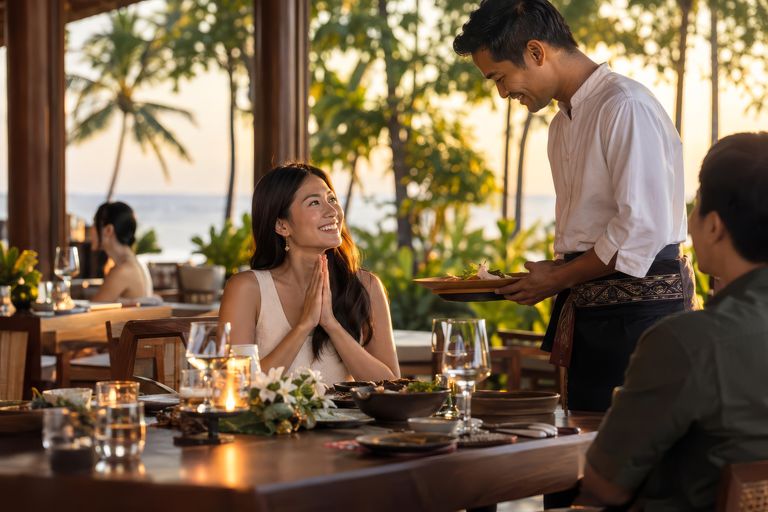
The wai goes with these words. It is the Thai greeting: palms pressed together at chest height, with a slight bow of the head. A wai also says thank you or sorry. Younger people give the first wai to older or more senior people, who then return it.
As a guest, you do not need to wai staff, drivers or shop assistants first. A smile and a nod are enough, with sawasdee or khop khun. If someone gives you a wai, return it. Our guide to Thai etiquette explains more customs, and our temple dress code guide covers what to wear for temple visits.

How do you count from 1 to 10 in Thai?
Thai numbers 1 to 10 are neung, song, sam, si, ha, hok, jet, paet, kao and sip. Learn these, plus roi for 100 and phan for 1,000, and you can understand most prices at markets, in taxis and in shops. Shop prices are usually shown in Western numbers too.
- 1: neung (หนึ่ง)
- 2: song (สอง)
- 3: sam (สาม)
- 4: si (สี่)
- 5: ha (ห้า)
- 6: hok (หก)
- 7: jet (เจ็ด)
- 8: paet (แปด)
- 9: kao (เก้า)
- 10: sip (สิบ)
- 100: roi (ร้อย); 1,000: phan (พัน)
Bigger numbers are built like English: song roi is 200, and sam phan is 3,000. Eleven is sip et (สิบเอ็ด), and twenty is yee sip (ยี่สิบ), two small exceptions worth knowing. For tips on paying and changing money, read our money guide.
When you hear a price, it is usually in baht, often shortened to the number alone. If you are unsure, ask the seller to type the number on a phone or calculator. This is common, and sellers expect it.
What should you say in a restaurant?
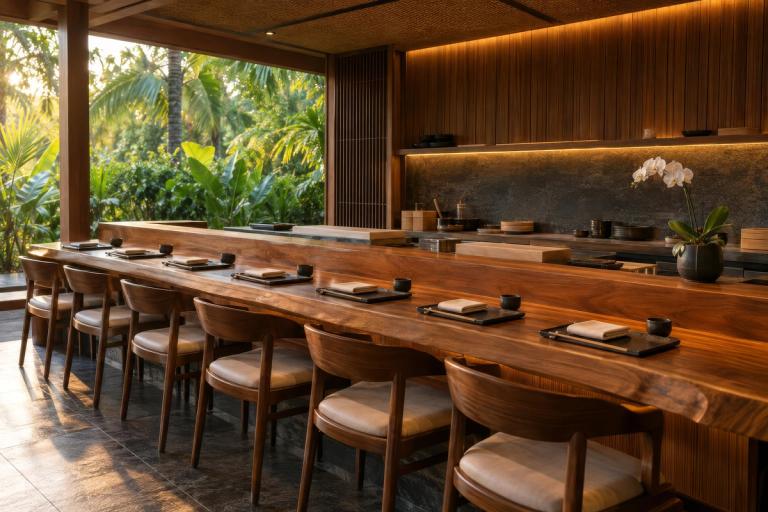
In restaurants, the most useful Thai phrases are about spice, water and the bill. Say mai phet for not spicy, and check bin when you want to pay. In fine-dining rooms the staff speak English, but these words help at a street stall or a local seafood restaurant.
- Not spicy, please: mai phet (ไม่เผ็ด)
- A little spicy: phet nit noi (เผ็ดนิดหน่อย)
- Menu, please: kho menu noi (ขอเมนูหน่อย)
- Plain water: nam plao (น้ำเปล่า)
- No ice: mai sai nam khaeng (ไม่ใส่น้ำแข็ง)
- No peanuts: mai sai thua (ไม่ใส่ถั่ว)
- Very delicious: aroi mak (อร่อยมาก)
- The bill, please: check bin (เช็คบิล)
For allergies, do not rely on a few words. Ask your hotel to write a card in Thai, or let our team call the restaurant before you arrive. Read our street food guide for the dishes worth ordering.
Thai meals are shared. Dishes arrive when they are ready, not in courses, and everyone takes a little from each plate with a spoon. The fork pushes food onto the spoon; chopsticks are used mainly for noodles. If you want the meal to come in order, ask the staff when you book.
What should you say to drivers, hotels and shops?
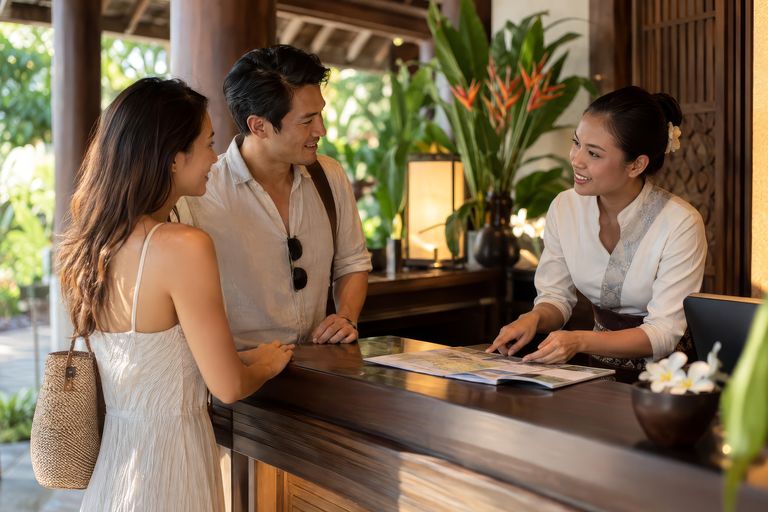
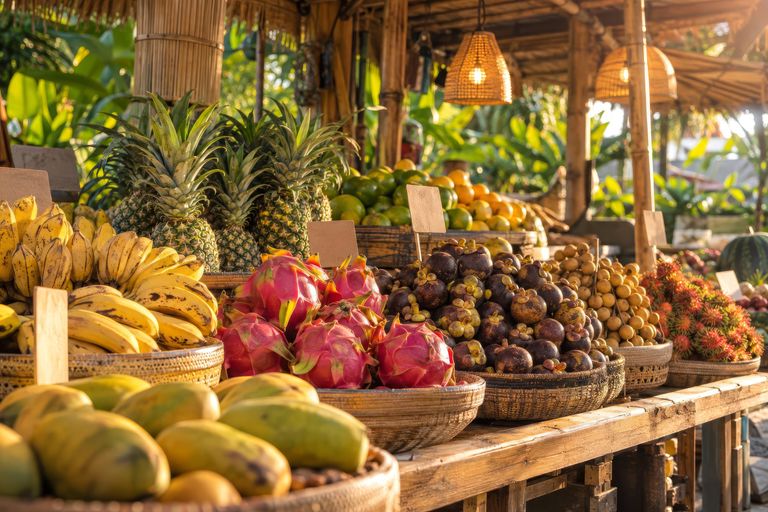
With a driver, the key phrases are left, right, straight on and stop here. In shops, ask how much and whether you can pay by card. Our chauffeurs speak English, but these words help with a local taxi, a boat driver or a small market stall.
- Turn left: liao sai (เลี้ยวซ้าย)
- Turn right: liao khwa (เลี้ยวขวา)
- Go straight: trong pai (ตรงไป)
- Stop here: jot trong nee (จอดตรงนี้)
- Slowly, please: cha cha noi (ช้าๆ หน่อย)
- Too expensive: phaeng pai (แพงไป)
- Can you reduce the price?: lot dai mai (ลดได้ไหม)
- Can I pay by card?: jai bat dai mai (จ่ายบัตรได้ไหม)
At markets, ask for a better price with a smile, and accept the answer politely. In malls and hotel shops, prices are fixed.
Many local drivers read Thai addresses more easily than English ones, so show the hotel card at night. Our team can also send the address to any driver by message before you set off.
Which Thai words should you use carefully?
Thai is a tonal language: the same sound said with a different tone can mean a different word. Chulalongkorn University lists five tones: mid, low, falling, high and rising. This is why simple English spellings only take you so far. Keep to the polite basics, speak slowly, and let your host help you with anything more.
A famous example is the sound mai. Said one way it means not (ไม่). Said with a rising tone it turns a sentence into a question (ไหม). Other tones give new (ใหม่) and wood (ไม้). Thai speakers hear the difference at once; you may not, and that is fine.
Avoid copying street slang from videos or social media. It can sound rude or strange from a guest. You may hear the word farang (ฝรั่ง). It means a foreigner of Western origin, and it is also the Thai word for guava. It is usually neutral, not an insult.
Tone of voice matters as much as words. Thai people value a calm, quiet manner, and raising your voice causes loss of face for everyone. If something goes wrong, smile, speak softly and ask for help. You will get a faster and kinder result.
Which phrases help on a night out?
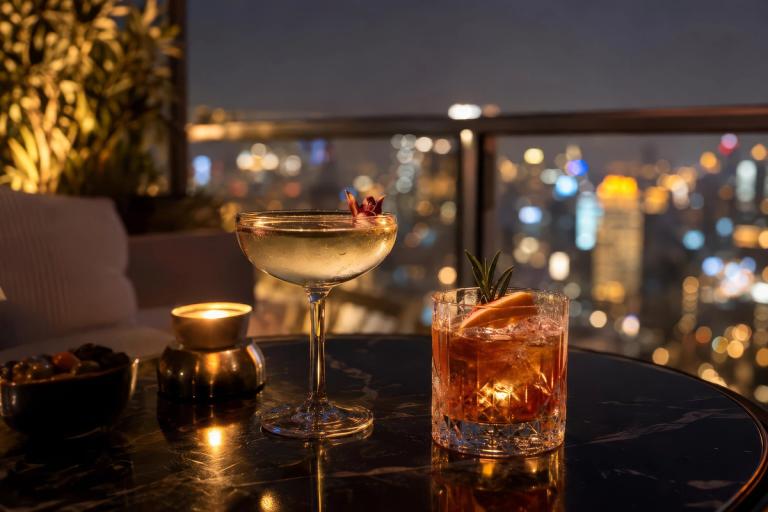
For a night out, the phrases you need are cheers, one more, where is the restroom and please call a car. Keep your tone friendly and relaxed. Bar staff in rooftop bars and clubs speak English, so these words are for warmth, not need.
- Cheers: chon kaew (ชนแก้ว)
- One more, please: eek neung (อีกหนึ่ง)
- Where is the restroom?: hong nam yoo tee nai (ห้องน้ำอยู่ที่ไหน)
- Please call a car: riak rot hai noi (เรียกรถให้หน่อย)
When we plan your evening, a driver waits for you, so you will rarely need the last phrase.
Thai law changed the shop hours for alcohol on 29 May 2026. Shops may now sell it from 11:00 to midnight, and the old afternoon break has ended. Hotels and licensed venues keep their own hours. On some Buddhist holidays sales stop for the day, so ask us before you plan a party.
How much Thai do you really need?
Very little. English is spoken widely in luxury hotels, fine-dining restaurants, spas and international shops, and by our chauffeurs and hosts. A few basic Thai phrases are not for survival; they are for warmth. Staff notice and value the effort, and the welcome you get becomes even kinder.
Learn sawasdee, khop khun, mai pen rai and aroi, with khrap or kha, before you land. That is enough for most trips. If you plan to explore local markets, temples or the countryside, we add a Thai-speaking guide who can explain as well as translate. A translation app on your phone helps with menus and signs, and the camera mode reads Thai script well enough for daily use. Our luxury chauffeur service includes English-speaking drivers in every main city.
Plan your trip with Tanner
Tanner can do the talking for you, from the driver to the restaurant booking. We arrange English-speaking chauffeurs and hosts, book restaurants with your allergies noted in Thai, and add a guide for temples and markets. Tell us where you are going, and we send one clear plan. For more practical advice before you travel, start with our Thailand essentials.